If you search for happy horse 1.0 vs seedance 2.0, you are usually not
looking for abstract hype. You are trying to decide which model better fits the
way your team actually makes video.
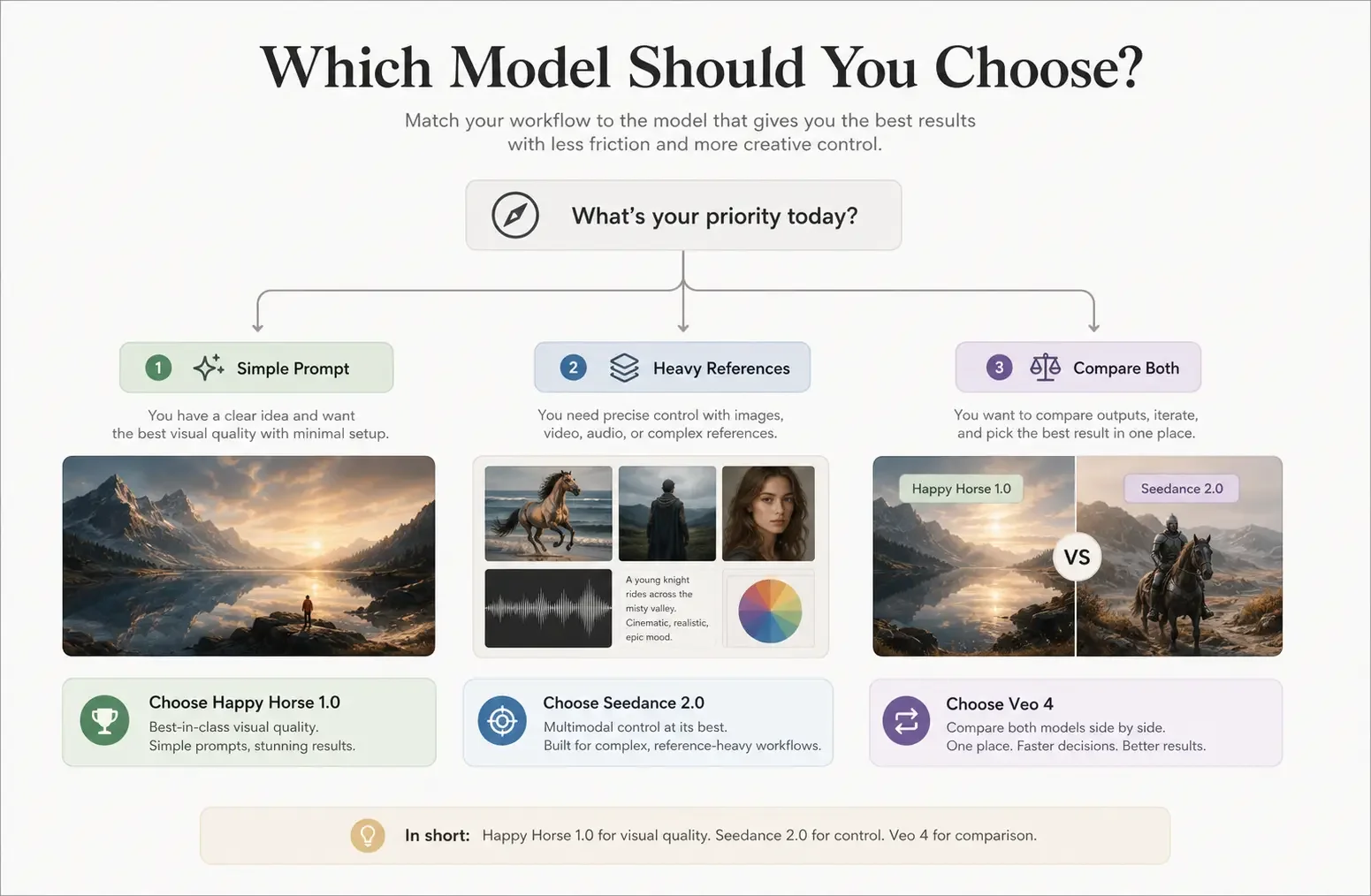
As of May 2, 2026, the cleanest public read is not that one model wins
everything. Happy Horse 1.0 looks stronger when the brief is simple and you
want the most striking result from text or one reference image. Seedance 2.0
looks stronger when the job needs audio, multiple references, editing,
extension, or tighter director-style control.
That distinction matters more than leaderboard talk. A real workflow depends on
how much setup you need, how many assets you must coordinate, and how much
control you want after the first generation.
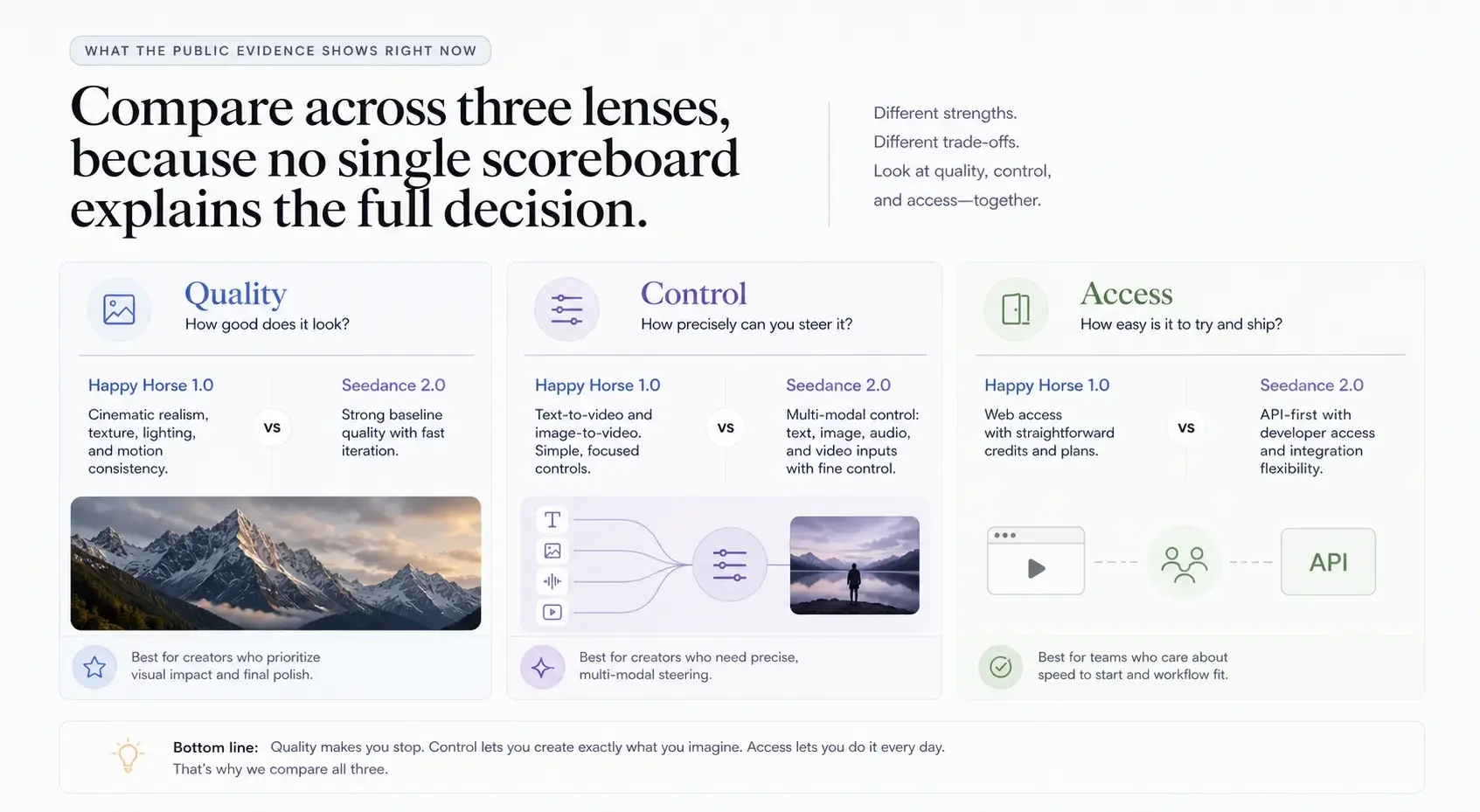
Current public pages emphasize multimodal workflows, native audio, editing, extension, and adaptive duration
HappyHorse is easier to reason about for short standalone clips
Reference control
One image plus optional prompt steering
Up to 9 images, 3 videos, and 3 audio files, plus editing and extension
Seedance clearly wins deep control
Audio story
Strong audio buzz, but a simpler public input surface
Native audio plus audio-file references in the same pipeline
Seedance wins audio-first workflows
Access signal
Public Alibaba model page with straightforward options
Public ByteDance model page plus official launch page and docs
Both are accessible, but Seedance looks more mature on documentation
Best current fit
Cinematic one-shot clips, prompt-led or single-image-led work
Reference-heavy ads, music-led scenes, edits, continuations, and multi-input production
The winner depends on workflow, not branding
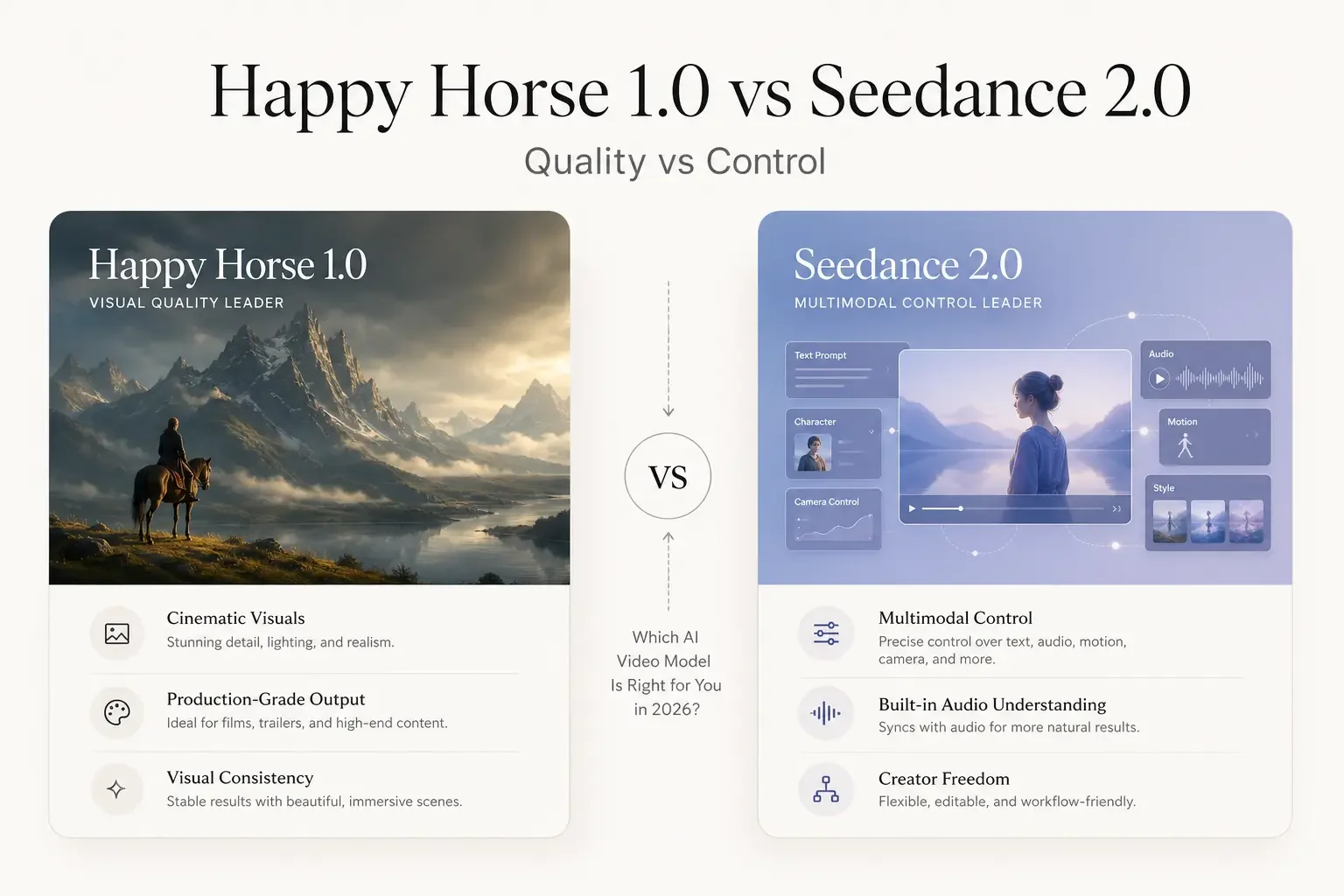
As of May 2, 2026, the most useful interpretation is that Happy Horse 1.0
is the quality-first option and Seedance 2.0 is the control-first
option. That is a much better decision frame than asking which one is “the
best” in the abstract.
Happy Horse 1.0 is easier to like when the input is small and the output still
needs to look premium. The public Alibaba model page is narrow on purpose: text
to video, or one still image into video, with 720p or 1080p output and up to
15 seconds. That is not a weakness by default. It means the workflow does not
ask you to manage a complex asset stack before you can get a strong result.
If you already know the shot you want, that simplicity is useful. It removes
setup friction and keeps the prompt as the main creative instrument.
image-to-video scenes where the first frame already does most of the work
This is also why it keeps attracting discussion around visual quality. The
model feels optimized for short, striking clips rather than for complex
multi-asset orchestration.
A lot of teams do not need maximum control. They need a good clip fast.
When you do not want to manage multiple reference files, label assets inside
the prompt, or decide whether a task is generation, extension, or editing, the
HappyHorse workflow is easier to operationalize. It fits teams that think in
terms of “one idea, one shot, one result.”
Choose Happy Horse 1.0 first when:
the prompt is already clear
one reference image is enough
you care more about visual finish than deep asset choreography
the output is a short standalone clip rather than part of a larger edit chain
Seedance 2.0 is built around a different thesis. Instead of saying “give me one
prompt and I will make a strong clip,” it says “give me the ingredients and I
will help you direct the scene.”
That shows up everywhere in the public docs. Seedance 2.0 accepts text, images,
video clips, and audio in one generation path. On the public model page, it
supports up to 9 images, 3 video clips, and 3 audio files in one job. That
is a massive difference from HappyHorse’s simpler surface.
If your workflow depends on character continuity, performance references, music
timing, or matching one clip to another, Seedance starts with the stronger tool
shape.
Seedance 2.0 is especially strong when the job is not just “make something
beautiful,” but “make something specific.”
That includes:
product videos that must preserve brand visuals
outfit or character continuity across shots
music-synced scenes
ads that need reference footage for pacing
video edits where you change one element without rebuilding the whole scene
scene extensions where the next shot must feel like the same world
This is where its native audio story matters too. Seedance does not only
generate audio with the clip. It can also use audio as part of the reference
stack, which gives it a better fit for rhythm-driven work.
Seedance 2.0 feels more mature when you think beyond one render.
Its public positioning already includes editing, extension, multimodal
references, and adaptive duration. That makes it easier to build repeatable
production routines around it. The model is not just an output engine. It is a
workflow engine.
Choose Seedance 2.0 first when:
you need more than one reference source
audio is part of the brief, not an afterthought
you expect revision rounds inside the same pipeline
the project depends on continuity, editing, or extension
No. HappyHorse 1.0 is stronger for simple, quality-first generation. Seedance
2.0 is stronger for control-first, reference-heavy, or edit-heavy workflows.
Seedance 2.0 is the safer answer when audio is central to the brief because its
public workflow treats audio as both generated output and reference input.
If one image is enough and the goal is a short polished result, HappyHorse 1.0
is a strong choice. If the task needs multiple references, audio timing, or
continuation logic, Seedance 2.0 is the better fit.
The cleanest answer to happy horse 1.0 vs seedance 2.0 is this:
HappyHorse 1.0 is the model to test first when you want the best-looking short
clip from a simple setup. Seedance 2.0 is the model to test first when you need
a richer control surface, heavier reference input, and a workflow that includes
editing, extension, and audio-aware direction.
That is why the real winner is not chosen by hype. It is chosen by the shape of
your workflow.
Happy Horse 1.0 vs Seedance 2.0: Which AI Video Model Is Better for Quality, Audio, and Control?
The Short Answer
What the Public Evidence Shows Right Now
Where Happy Horse 1.0 Is Ahead Right Now
1. It is the better pick for a simple brief with high visual expectations
2. It is easier to justify when the goal is one-shot cinematic output
3. It asks less from the operator
Where Seedance 2.0 Is Ahead Right Now
1. It is the control-first model
2. It is better for reference-heavy and audio-led work
3. It is easier to justify for production systems, not just single clips
Which Model Should You Choose?
How Veo 4 Fits This Decision
FAQ
Is Happy Horse 1.0 better than Seedance 2.0 overall?