Editor's Note: This article contains speculative analysis based on existing product trends. Nano Banana 3 has not been officially announced by Google DeepMind as of April 2026.
The AI image generation landscape has witnessed remarkable evolution over the past year, with Google DeepMind's Nano Banana series leading the charge. From the viral sensation of the original Nano Banana in August 2025 to the lightning-fast Nano Banana 2 released in February 2026, each iteration has pushed the boundaries of what's possible in AI-powered visual creation. Now, as creative professionals and AI enthusiasts scrutinize Google's development patterns, one question dominates the conversation: Is Nano Banana 3 on the horizon?
To answer this question, we need to examine the real technological trajectory of the , understand the gaps that still exist in current models, and analyze what Google's broader AI strategy reveals about future releases. With Veo 4 offering seamless access to multiple cutting-edge AI models in one unified platform, understanding where Nano Banana is headed becomes crucial for anyone building visual content workflows in 2026.
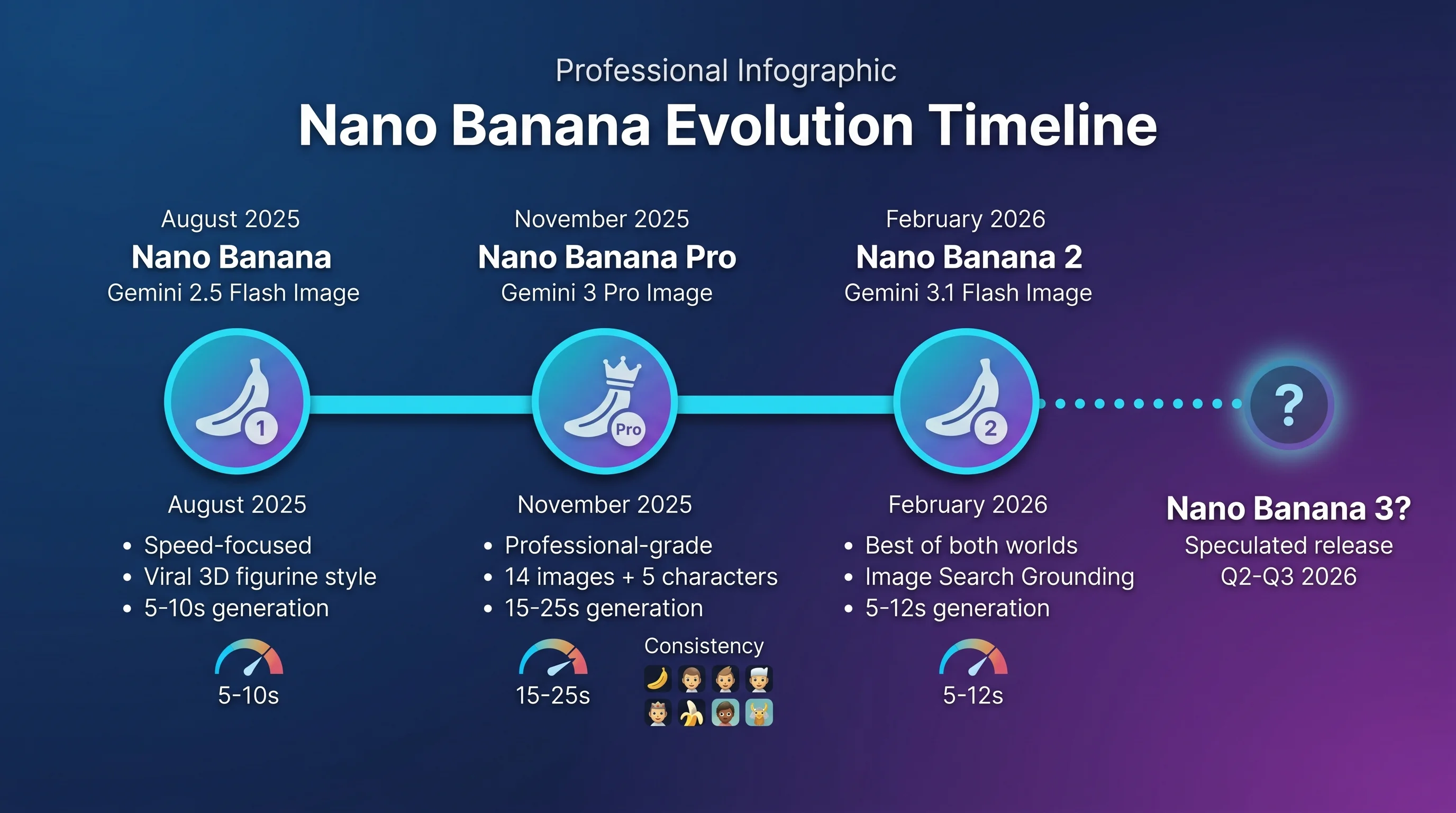
Before speculating about Nano Banana 3, we must understand the actual progression that brought us here. The Nano Banana series represents three distinct philosophical approaches to image generation, each built on different Gemini foundation models.
Launched in August 2025, the original Nano Banana emerged from secret public testing on Arena under a codename that would eventually become its official brand. The model gained instant viral traction, particularly for its photorealistic "3D figurine" aesthetic that dominated social media feeds. Built on Gemini 2.5 Flash Image, it prioritized speed and accessibility, making AI image generation feel genuinely democratic for the first time.
The original model excelled at rapid iteration and conceptual exploration, but it carried limitations that professional users quickly identified: inconsistent spatial reasoning in complex scenes, limited text rendering accuracy, and challenges maintaining character consistency across multiple generations.
Released in November 2025, Nano Banana Pro represented a fundamental shift toward professional-grade production. Built on Gemini 3 Pro Image, it introduced advanced reasoning capabilities that transformed how the model understood and executed complex prompts. The Pro version could blend up to 14 images while maintaining consistency across 5 characters, a breakthrough for storyboarding and narrative visual development.
Nano Banana Pro also introduced a "thinking" mechanism similar to text-based reasoning models, where the system generates up to 2 intermediate test images before producing the final output. This approach dramatically improved composition quality, text rendering, and adherence to complex instructions, though it came at the cost of generation speed.
February 2026 brought Nano Banana 2, Google's attempt to merge Pro-level capabilities with Flash-level speed. Built on Gemini 3.1 Flash Image, this model introduced Image Search Grounding, the ability to pull real-world references during generation, dramatically improving accuracy for specific locations, objects, and environments.
Real-world testing confirms that Nano Banana 2 delivers significantly improved lighting realism, natural skin tones, and accurate shadow gradients compared to Pro, while generating images substantially faster. The model maintains subject consistency across up to 5 characters and 14 objects, matching Pro's capabilities while operating at Flash speed.
To predict whether Nano Banana 3 makes sense, we must identify the gaps that current models haven't addressed. Despite the impressive capabilities of Nano Banana 2, several pain points remain for professional creative operations.
While Nano Banana 2 supports iterative editing, maintaining visual coherence across extended editing sessions remains inconsistent. Professional workflows often require 10-15 refinement steps to reach final approval, and current models struggle to preserve subtle stylistic elements across these iterations. The "thought signature" mechanism in Pro helps, but it's not yet seamless enough for production environments where brand consistency is non-negotiable.
Google's Veo 3 handles video generation separately from Nano Banana's image capabilities. For creators building cohesive visual narratives, the disconnect between still image generation and video workflows creates friction. A hypothetical Nano Banana 3 could bridge this gap, offering native image-to-video transitions or frame-level consistency that matches Veo's temporal coherence.
Current models excel at interpreting natural language prompts, but they lack the granular spatial control that professional designers often need. Tools like ControlNet for Stable Diffusion demonstrate the value of skeleton-based pose control, depth map guidance, and edge-aware generation. Nano Banana 2's Image Search Grounding moves in this direction, but it doesn't yet offer the precision that complex commercial projects demand.
As AI image generation moves from individual experimentation to team-based production, the need for collaborative workflows becomes critical. Current Nano Banana implementations operate as single-user experiences. A future iteration could introduce shared style libraries, team-level consistency anchors, and approval workflows that integrate with existing creative operations infrastructure.
Google's release cadence and strategic positioning offer clues about potential future directions. Examining the timeline reveals a deliberate pattern:
August 2025: Nano Banana (consumer-focused, viral appeal)
November 2025: Nano Banana Pro (professional upgrade, 3 months later)
February 2026: Nano Banana 2 (speed-quality fusion, 3 months later)
This consistent quarterly rhythm suggests Google operates on a rapid iteration cycle for image generation, likely driven by competitive pressure from OpenAI's GPT Image series, ByteDance's Seedream models, and the open-source Stable Diffusion ecosystem.
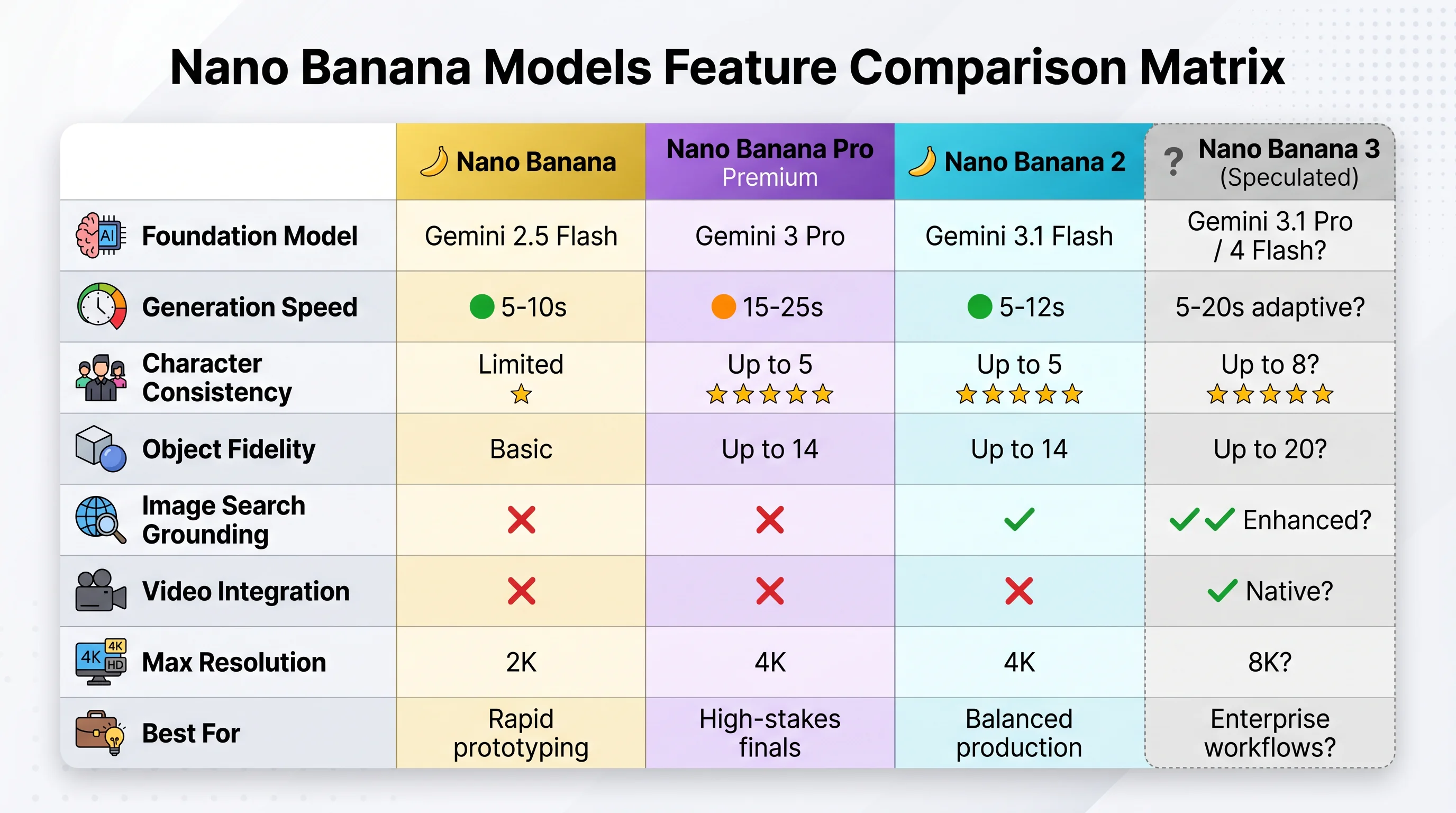
Each Nano Banana version maps directly to a Gemini foundation model release. Nano Banana 3 would logically build on either Gemini 3.1 Pro or a hypothetical Gemini 4 Flash. Google's recent release notes mention Gemini 3.1 Pro Preview with enhanced tool prioritization and custom tool support, suggesting the underlying reasoning infrastructure continues to evolve.
The Apple-Google AI partnership announced in early 2026 adds another dimension. With Apple planning to integrate Gemini-powered image generation into Siri for iOS 27, Google has strategic incentive to maintain technological leadership in this space. A Nano Banana 3 release timed with Apple's WWDC in June 2026 would make commercial sense.
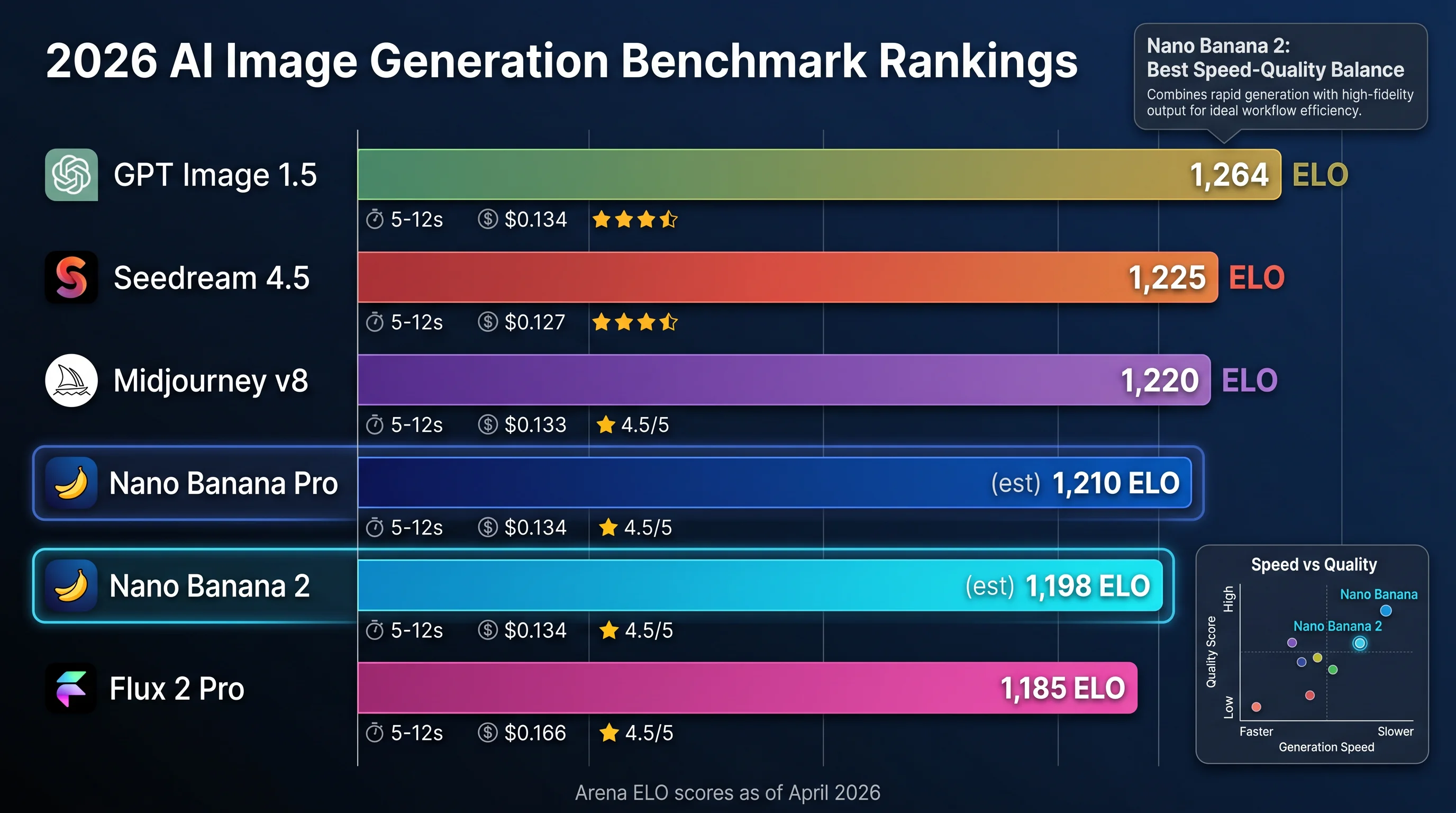
The 2026 AI image generation landscape is intensely competitive. OpenAI's GPT Image 1.5 currently holds the top Arena ELO ranking at 1,264, with ByteDance's Seedream 4.5 close behind at 1,225. While Nano Banana 2 performs strongly, it doesn't dominate benchmarks the way the original Nano Banana did in late 2025.
Google has historically responded aggressively to competitive threats. The rapid progression from Nano Banana to Pro to 2 demonstrates willingness to iterate quickly rather than waiting for perfect solutions. If internal benchmarks show Nano Banana 2 losing ground to competitors, a Nano Banana 3 release could arrive sooner than the established quarterly pattern suggests.
Integration with Veo 3's video generation pipeline would allow seamless transitions from still images to animated sequences. Imagine generating a hero product image in Nano Banana 3, then extending it into a 10-second video ad with consistent lighting, perspective, and style, all within a single workflow. This addresses the current disconnect between Google's image and video generation tools.
Building on Nano Banana 2's Image Search Grounding, a third iteration could introduce depth-aware generation, allowing users to specify foreground-background relationships with precision. This would compete directly with ControlNet-style approaches while maintaining Nano Banana's natural language interface.
Rather than being a standalone model, Nano Banana 3 could function as an intelligent orchestration layer that dynamically selects between Pro-level reasoning and Flash-level speed based on prompt complexity. This would eliminate the current decision fatigue where users must manually choose between models for each generation.
For enterprise users, the ability to lock specific visual elements, brand colors, logo placement, product dimensions, across thousands of generations would transform Nano Banana from a creative tool into a production system. This feature would directly address the human-in-the-loop quality control bottleneck that currently limits high-volume creative operations.
Regardless of when or whether Nano Banana 3 arrives, the conversation highlights a crucial reality for creative professionals: model access matters as much as model capability. Veo 4 offers a unified platform where users can access multiple state-of-the-art image and video generation models without juggling separate subscriptions, API keys, or learning curves.
When Nano Banana 2 launched in February 2026, early adopters faced a fragmented landscape: some features appeared first in Google AI Studio, others in Vertex AI, and consumer access came through the Gemini app with different resolution limits. Veo 4 eliminates this friction by providing immediate access to the latest models as they're released, with consistent pricing and a streamlined interface designed for production workflows.
For teams building visual content at scale, this integration advantage compounds over time. Rather than rebuilding pipelines every time Google releases a new model version, Veo 4 users benefit from automatic updates and backward compatibility. Whether Nano Banana 3 arrives in June 2026 or later, Veo 4 ensures you'll have day-one access without disrupting existing workflows.
Note: Arena ELO scores for Nano Banana models are estimated based on comparative testing, as Google does not publish official Arena rankings. Benchmarks compiled from multiple sources.
Understanding the practical differences between current Nano Banana versions, and anticipating where a hypothetical Nano Banana 3 might fit, requires examining real creative workflows.
For Instagram Reels, TikToks, and YouTube Shorts, Nano Banana 2's speed and Image Search Grounding deliver the best balance. Creators generating 50+ concept images per week benefit from the rapid iteration cycle, and the model's improved lighting realism translates well to mobile screens. The ability to reference real-world locations through search grounding means travel influencers and lifestyle creators can generate contextually accurate backgrounds without expensive photo shoots.
High-volume e-commerce operations face a unique challenge: generating thousands of product variations while maintaining absolute brand consistency. Current Nano Banana models struggle here because they lack rigid style anchors. Teams end up using Nano Banana Pro for initial hero images, then manually enforcing consistency across variations, a workflow that negates much of AI's efficiency promise.
A hypothetical Nano Banana 3 with production-grade consistency anchors would transform this use case. Imagine locking your brand's exact color palette, lighting setup, and composition rules once, then generating 500 product images that all adhere perfectly to those constraints. This capability would position Nano Banana as an enterprise production tool rather than just a creative exploration platform.
Text-heavy imagery remains a persistent challenge for most AI image generators. While Nano Banana 2 has improved text rendering, it still occasionally produces distorted letters or inconsistent typography. News organizations creating infographics, data visualizations, and illustrated articles need pixel-perfect text accuracy.
Seedream 4.5 currently leads in this category, but Google's track record with text understanding in Gemini language models suggests they have the technical foundation to excel here. If Nano Banana 3 prioritizes native typography rendering, treating text as a first-class element rather than just another visual feature, it could capture significant market share in editorial workflows.
Concept artists and storyboard professionals represent a high-value user segment that current Nano Banana models serve imperfectly. These users need frame-level consistency across dozens or hundreds of images, precise character pose control, and the ability to maintain specific camera angles and lighting setups.
Nano Banana Pro's multi-image fusion and character consistency features move in this direction, but they don't match the control that tools like ControlNet provide for Stable Diffusion. A Nano Banana 3 that integrates depth-aware generation and skeleton-based pose control while maintaining Google's natural language interface would offer a compelling alternative to open-source workflows that currently require significant technical expertise.
Google's annual developer conference represents the most logical announcement venue. With Apple's WWDC scheduled for June 8, 2026, and the Apple-Google AI partnership bringing Gemini-powered features to iOS 27, Google has strategic incentive to showcase image generation leadership before Apple's event.
However, the February 2026 release of Nano Banana 2 means only three months would separate the launches, potentially too soon for a major iteration unless Google perceives urgent competitive pressure.
A mid-year release would maintain the quarterly cadence established by previous versions while allowing sufficient time for meaningful technical advancement. This timeline also aligns with the typical enterprise budget cycle, when organizations finalize creative operations tooling for the second half of the year.
Google might choose to iterate Nano Banana 2 through incremental updates rather than launching a distinct Nano Banana 3. The model's Image Search Grounding feature, for example, could be progressively enhanced to include depth awareness and spatial control without requiring a full version bump.
This approach would mirror how Stable Diffusion evolved through point releases (3.0, 3.5, 3.5 Large) rather than major version jumps. For users, the distinction matters less than continuous improvement in capabilities.
While speculation about Nano Banana 3 is intellectually interesting, practical decisions require focusing on current reality. Here's how to optimize your visual content workflow in April 2026:
For rapid prototyping, social media content, and iterative exploration, Nano Banana 2 delivers the best speed-quality balance. Its Image Search Grounding feature particularly shines when generating location-specific or product-focused imagery where real-world accuracy matters.
When you need maximum quality for hero images, complex compositions, or text-heavy designs, Nano Banana Pro's reasoning mechanism justifies the slower generation time. The intermediate image approach means you're more likely to get usable results on the first generation, reducing overall time-to-final despite longer per-image latency.
Rather than committing to a single model, Veo 4 allows you to fluidly switch between Nano Banana 2, Pro, and other cutting-edge models based on specific project requirements. This flexibility becomes increasingly valuable as new models launch and the competitive landscape evolves.
For a four-person creative studio, Veo 4's unified platform can reduce operational costs by up to 80% compared to managing separate subscriptions for each model provider. The Relax mode for Pro subscribers enables unlimited generation during off-peak hours, transforming fixed per-image costs into predictable monthly expenses.
Whether Nano Banana 3 arrives in June 2026, later this year, or not at all, several strategic principles remain constant:
Model capability matters less than workflow integration. The best AI image generator is the one that fits seamlessly into your existing creative operations, not necessarily the one with the highest benchmark scores.
Speed and quality are no longer mutually exclusive. Nano Banana 2 proves that Flash-level speed can coexist with Pro-level capabilities, eliminating the false choice between iteration velocity and output quality.
Platform consolidation reduces operational friction. Managing multiple model subscriptions, learning different interfaces, and rebuilding pipelines for each new release creates hidden costs that compound over time. Veo 4's unified approach addresses this directly.
The competitive landscape drives rapid innovation. With OpenAI, ByteDance, Stability AI, and others pushing boundaries, Google must maintain aggressive iteration cycles. This benefits users through continuous improvement but requires flexible tooling that adapts to frequent updates.
Enterprise features will differentiate future releases. As AI image generation matures beyond individual experimentation, production-grade features like consistency anchors, team collaboration, and brand compliance tools will become key differentiators.
The question "Is Nano Banana 3 coming?" might be less important than recognizing that AI image generation has entered a phase of continuous, iterative improvement rather than revolutionary leaps. Each Nano Banana release has delivered meaningful but incremental advances: better speed, improved reasoning, enhanced grounding in real-world knowledge.
A hypothetical Nano Banana 3 would likely continue this pattern, bridging the video generation gap, adding spatial control mechanisms, or introducing enterprise-grade consistency features. These improvements would be valuable, but they represent evolution rather than transformation.
For creative professionals and teams building visual content workflows in 2026, the strategic imperative is clear: build on flexible foundations that adapt to rapid model evolution. Veo 4 provides exactly this foundation, offering immediate access to the latest AI image and video generation models through a unified, production-ready platform.
Whether Nano Banana 3 arrives next month or next year, Veo 4 ensures you'll be ready to leverage it from day one, without disrupting existing workflows, retraining teams, or rebuilding infrastructure. In a landscape defined by relentless innovation, that adaptability might be the most valuable capability of all.
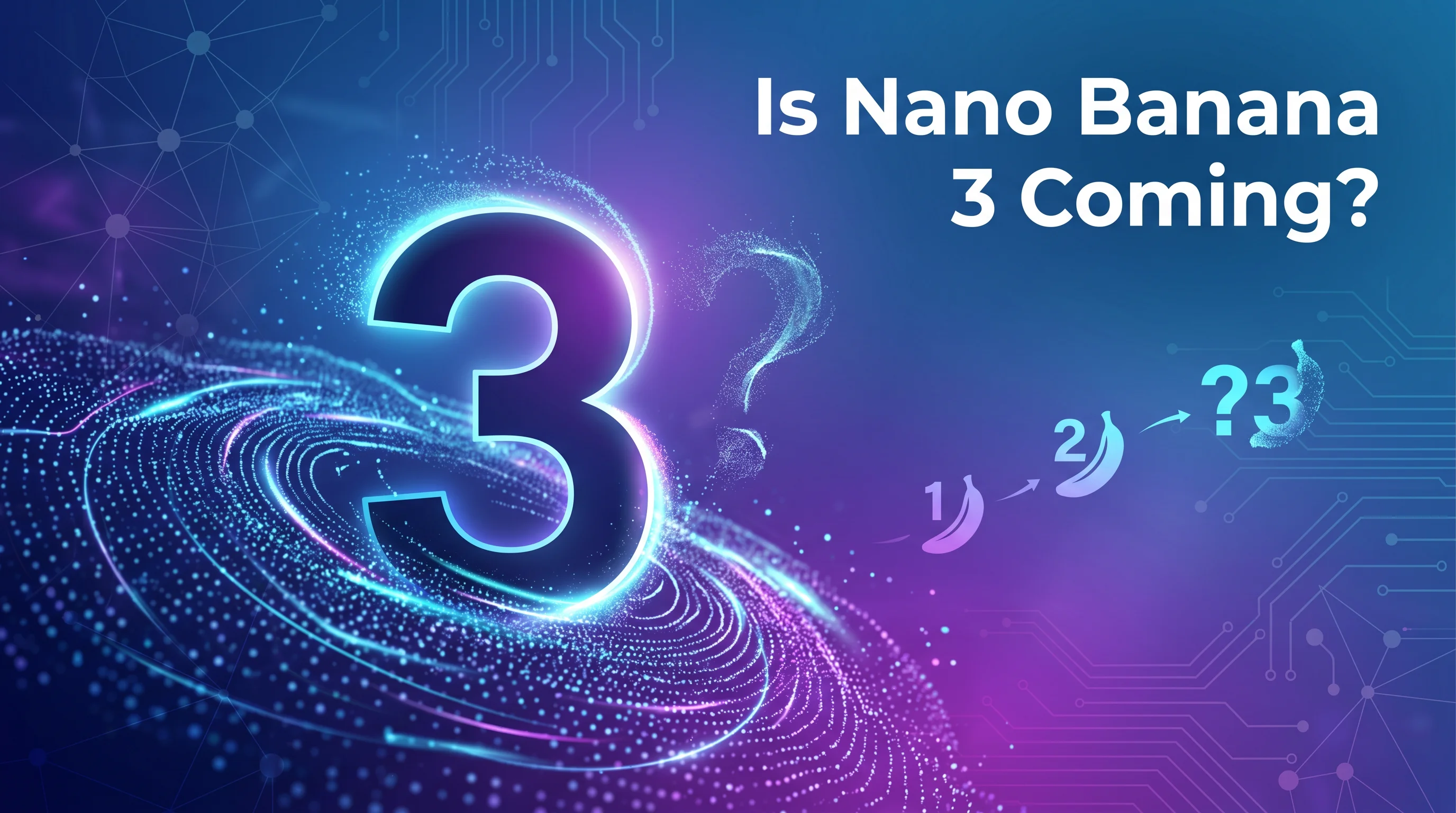
Is Nano Banana 3 Coming? What Google's Image Generation Roadmap Tells Us
The Evolution Story: From Nano Banana to Nano Banana 2
Nano Banana (Gemini 2.5 Flash Image): The Viral Beginning
Nano Banana Pro (Gemini 3 Pro Image): The Professional Upgrade
Nano Banana 2 (Gemini 3.1 Flash Image): The Best of Both Worlds
The Current Landscape: What's Missing in 2026?
The Multi-Turn Editing Challenge
Video Integration Gap
Advanced Composition Control
Real-Time Collaborative Generation
Analyzing Google's Development Patterns
The Gemini Foundation Model Strategy
Competitive Benchmark Pressure
What Nano Banana 3 Could Realistically Offer
Enhanced Temporal Consistency for Video Workflows
Advanced Spatial Control Mechanisms
Native Multi-Model Orchestration
Production-Grade Consistency Anchors
The Veo 4 Advantage: Why Platform Integration Matters
Comparison Table: Nano Banana Evolution and Hypothetical Nano Banana 3
Technical Benchmarks: Where Nano Banana Stands in 2026
Real-World Use Cases: When to Choose Which Model
Social Media Content Creation
E-Commerce Product Visualization
Editorial and News Media
Film and Animation Pre-Production
The Timing Question: When Could Nano Banana 3 Arrive?
Google I/O 2026 (Mid-May)
Q3 2026 (July-September)
Alternative Scenario: Incremental Updates Instead
What This Means for Your Creative Workflow Today
Start with Nano Banana 2 for Volume Work
Reserve Nano Banana Pro for Final Assets
Leverage Veo 4's Multi-Model Access
Key Takeaways: Preparing for the Next Evolution
Conclusion: The Future Is Iterative, Not Revolutionary