The AI video generation landscape experienced a seismic shift in early 2026
when Happy Horse 1.0 emerged seemingly out of nowhere, immediately claiming
the top position on the Artificial Analysis Video Arena leaderboard. This
mysterious model dethroned established giants including Kling 3.0, Seedance
2.0, and even Google's Veo, sparking intense debate across the AI filmmaking
community about which model truly deserves the crown.
If you're navigating the rapidly evolving world of AI video generation,
understanding the fundamental differences between Happy Horse 1.0 and Kling
3.0 isn't just academic. It directly impacts your production workflow, output
quality, and budget allocation. This guide compares both models across
architecture, performance benchmarks, generation speed, audio capabilities,
character consistency, and real-world use cases. If you prefer to look at the
broader workflow before judging a single model pair, our
page is a useful starting point.
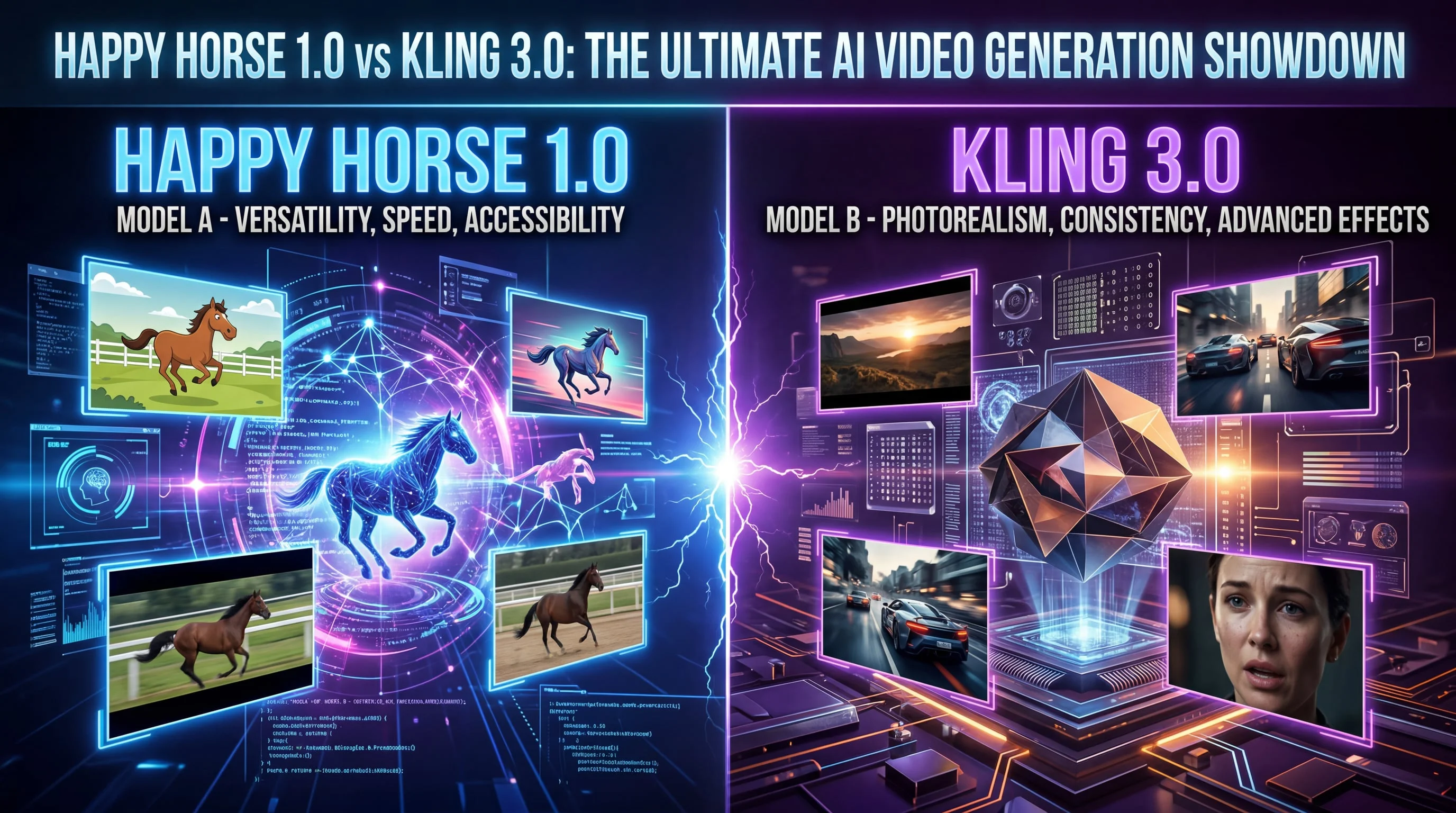
Happy Horse 1.0 vs Kling 3.0: The Ultimate AI Video Generation Showdown | Blog
Happy Horse 1.0 represents a new approach to AI video generation, built on a
15-billion-parameter unified 40-layer self-attention Transformer architecture.
What makes this model particularly intriguing is its anonymous debut. It
appeared on the Artificial Analysis Video Arena as a mystery model before any
official announcement, then surged to the top of both text-to-video and
image-to-video leaderboards. The fuller backstory behind that rise sits in
What Is HappyHorse 1.0? The Mystery Video Model That Reached #1.
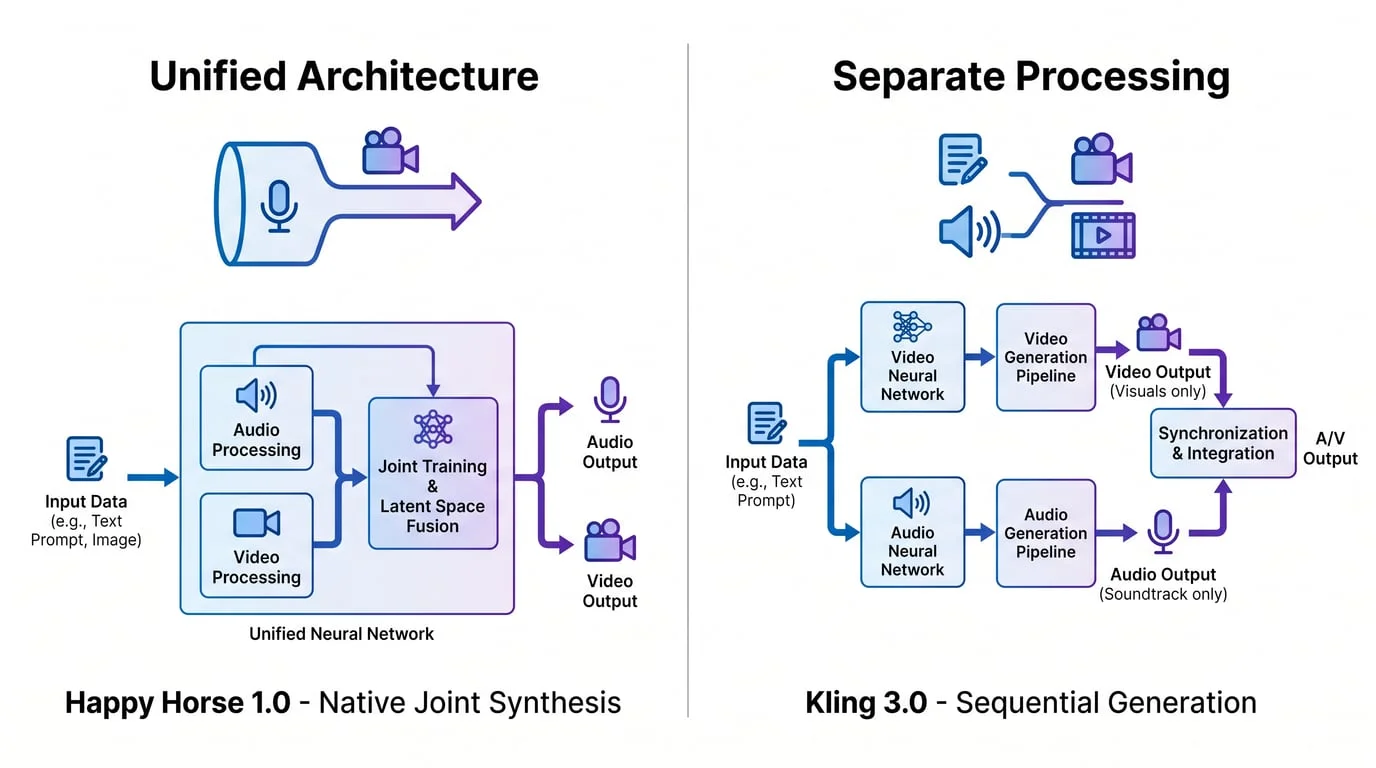
The model's headline innovation lies in its native joint audio-video synthesis
capability. Unlike virtually every competitor that generates silent video and
requires separate audio processing pipelines, Happy Horse 1.0 produces
synchronized video frames and corresponding audio tracks, including dialogue,
ambient sounds, and Foley effects, in a single forward pass through its
Dual-Branch DiT architecture. This is not merely a convenience feature. It
fundamentally changes post-production workflows by eliminating the need for
separate audio dubbing and synchronization.
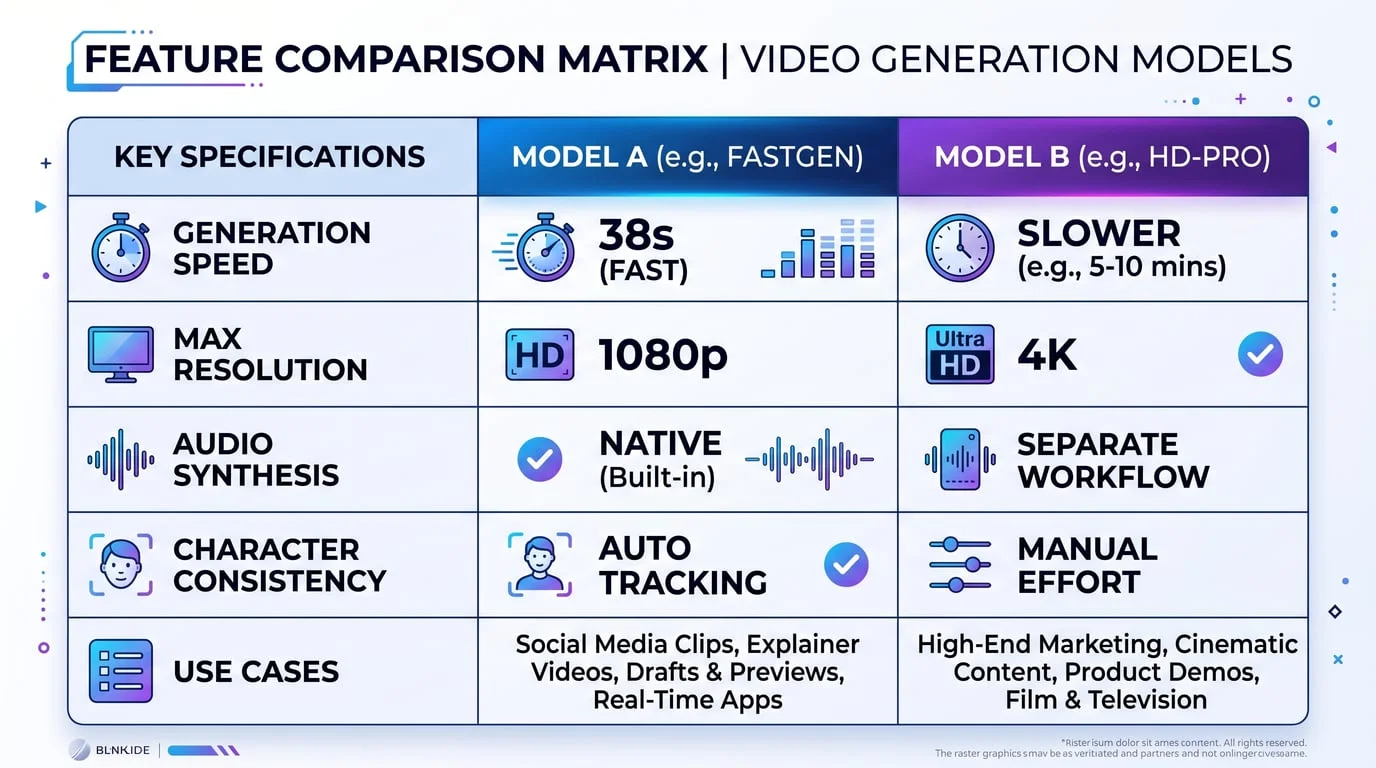
Powered by DMD-2 distillation technology, the model requires only 8 denoising
steps without classifier-free guidance, enabling it to generate 1080p video in
approximately 38 seconds on an NVIDIA H100 GPU. According to official
benchmarks, this represents a 30% speed advantage over Seedance 1.5 Pro and
29% faster generation compared to Kling 2.1. The model supports phoneme-level
lip synchronization across 7 languages: English, Mandarin, Cantonese,
Japanese, Korean, German, and French, with a reported Word Error Rate of
14.60%, meaning roughly 14 in 100 spoken words do not perfectly match lip
movements in generated video.
Perhaps most significantly for the developer community, Happy Horse 1.0 has
been described as committed to open-source release, with model weights
scheduled for public availability. This positions it as potentially the first
state-of-the-art AI video generator that combines frontier-level performance
with complete transparency and customizability, though as of April 2026, the
weights have not yet been publicly released.
Kling 3.0, released by Kuaishou in February 2026, established itself as a
commercial-grade production tool before Happy Horse's emergence. The model made
headlines as the first AI video generator capable of producing native 4K
resolution at 60fps, not upscaled or approximated, but genuinely rendered at
that specification.
Kling 3.0's core strength lies in its image-to-video workflow and
multi-character consistency. Industry reviewers consistently rate it as the
highest-scoring AI video model for maintaining character identity across
multiple shots and scenes, a critical capability for narrative filmmaking and
branded content production. The model employs a physics-aware motion system
that makes actions like walking, turning, and object interaction appear
significantly more natural than previous generations, addressing the floaty
movement quality that plagued earlier AI video models.
The model's AI Director system automatically handles shot composition, camera
movement execution, and lighting quality with professional-grade consistency.
This makes Kling 3.0 particularly reliable for structured production workflows
where specific camera movements must be delivered predictably. Photorealistic
surface textures, including skin, fabric, metal, and water, render with
exceptional accuracy, making it the preferred choice for product visualization
and commercial advertising.
Kling 3.0 also introduced robust video-to-video editing capabilities through
Kling 3 Edit mode, enabling style transfer and refinement of existing footage.
This positions it not just as a generation tool but as a more comprehensive
video production system.
The most objective measure of AI video quality comes from blind user voting in
the Artificial Analysis Video Arena, where users compare videos generated from
identical prompts without knowing which model created each output. The results
reveal a clear performance hierarchy that surprised many industry observers.
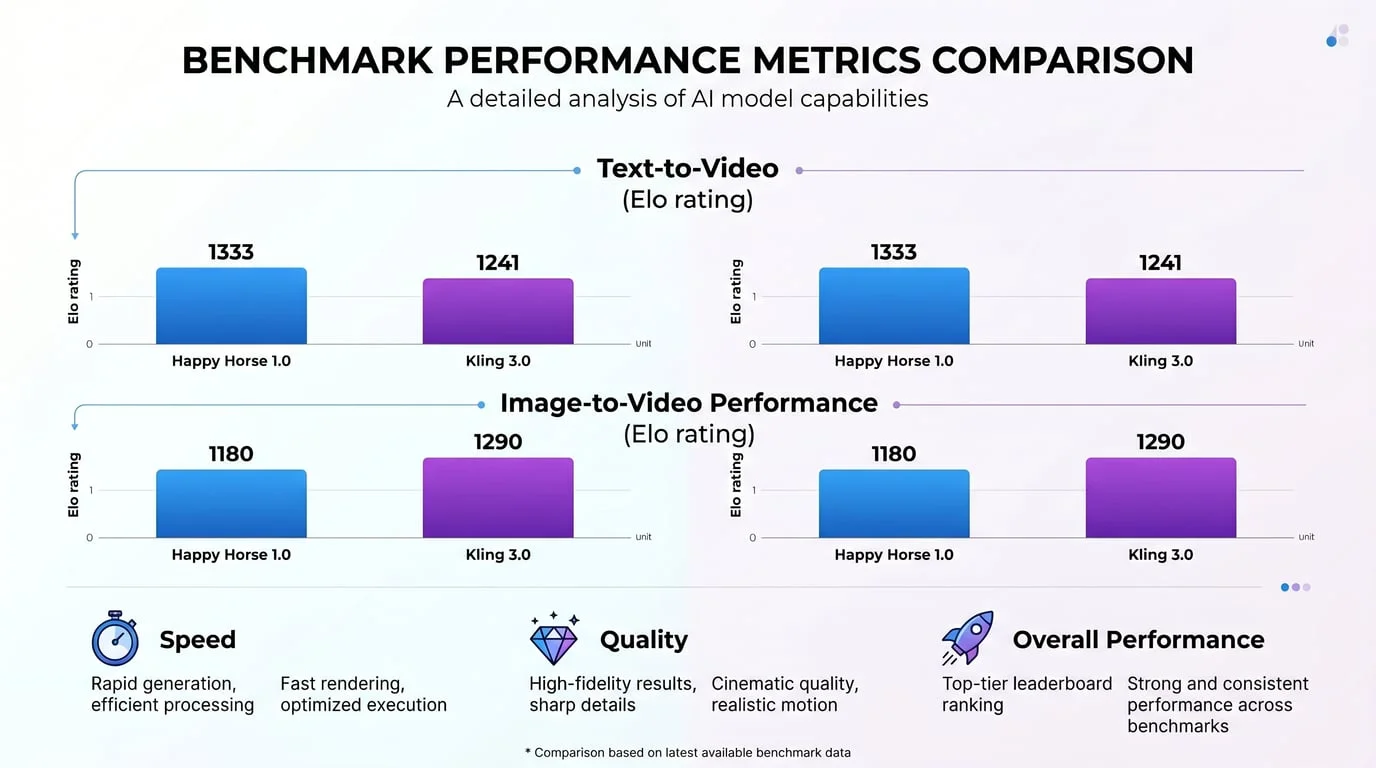
As of April 2026, Happy Horse 1.0 leads the Text-to-Video Arena without audio
with significant margins over Kling 3.0. In recent leaderboard snapshots,
Happy Horse 1.0 consistently ranks #1 in pure visual quality categories,
while Kling 3.0 typically positions at #4 or lower in text-to-video blind
tests. According to multiple independent sources, Happy Horse 1.0 leads
Seedance 2.0 by approximately 60 Elo points in text-to-video without audio and
holds meaningful leads in image-to-video categories as well.
To contextualize these numbers: in Elo rating systems, a 60 to 100 point
advantage typically translates to approximately a 60 to 65 percent win rate in
direct comparisons. Happy Horse's lead over Kling 3.0 represents what analysts
describe as a generational gap in blind testing performance for pure visual
quality.
However, the picture becomes more nuanced when considering specialized
capabilities. While Happy Horse 1.0 dominates in visual aesthetics and overall
quality, Kling 3.0 leads in motion control precision, and Seedance 2.0 excels
in multimodal and audio capabilities when evaluated through different lenses.
Beyond numerical scores, professional creators who have tested both models
extensively report distinct quality signatures. Happy Horse 1.0 consistently
delivers what reviewers describe as nuanced lighting, rich textures, and
sophisticated lens work that feels cinematic rather than artificially
generated. One industry analysis noted that Happy Horse's strength comes from
its prompt adherence, scene continuity, and cinematic motion realism in
high-definition video synthesis, three dimensions where most current AI video
generators have struggled to keep pace with user expectations.
Kling 3.0's strength manifests differently. Its photorealistic surface
rendering and physics-aware motion system excel in scenarios requiring accurate
material representation, such as product shots, commercial advertising, and
any content where surface detail and color reproduction must be precise. The
model's 4K/60fps capability provides motion clarity that becomes particularly
valuable for action sequences, sports content, and product demonstrations where
temporal resolution matters.
Speed matters in production environments, and the performance gap between these
models is substantial. Happy Horse 1.0's DMD-2 distillation enables 1080p
generation in approximately 38 seconds on H100 hardware, with lower-resolution
256p previews rendering in roughly 2 seconds. Some sources even claim Happy
Horse 1.0 averages approximately 10 seconds per generation in optimized
conditions, making it one of the fastest AI video models available.
Kling 3.0's generation speed varies significantly based on resolution and
quality settings. The Standard 720p mode processes faster than Pro 1080p, and
the native 4K output, while groundbreaking, requires substantially longer
generation times. Users report that queue times can extend significantly during
peak usage periods, particularly on free-tier access.
For iterative workflows where creators generate multiple variations to select
the best output, Happy Horse's speed advantage compounds. Generating 10
variations for selection takes approximately 6 to 8 minutes with Happy Horse
versus potentially 15 to 25 minutes with Kling 3.0 at comparable quality
settings, a difference that becomes meaningful across a full production day.
This represents perhaps the most fundamental architectural difference between
the models. Happy Horse 1.0's unified Transformer generates audio and video
jointly through its Dual-Branch DiT, producing synchronized dialogue, ambient
sounds, and Foley effects that are temporally aligned at the frame level. The
model supports 7-language phoneme-level lip sync with ultra-low WER, meaning
characters' mouth movements match spoken dialogue with professional-grade
accuracy.
According to official documentation, audio is generated in the same forward
pass as video, not post-dubbed or added afterward. The model processes text,
video, and audio tokens together from the start. Leaderboard data supports
this claim: Happy Horse ranks highly in both text-to-video and image-to-video
categories with audio enabled.
Kling 3.0 takes the conventional approach: generate silent video first, then
process audio separately. While Kling 3.0 includes audio generation
capabilities, the audio and video pipelines remain distinct, requiring
additional processing steps and potential synchronization adjustments. This is
not inherently inferior. Separate pipelines offer more granular control over
each modality, but they do introduce extra production steps and potential
misalignment issues.
For content creators producing dialogue-heavy content, explainer videos, or
multilingual marketing materials, Happy Horse's native audio synthesis
eliminates an entire post-production stage. For creators who prefer to add
custom soundtracks, sound effects, or voiceovers anyway, Kling's approach may
offer more flexibility.
Kling 3.0 has established itself as the industry leader in multi-character
consistency, a critical capability for narrative filmmaking. The model's
ability to maintain character identity across multiple shots and scenes
consistently earns praise from professional creators. Industry analyses confirm
that Kling 3.0 is the strongest multi-character model in its category, with
platform features allowing creators to define characters with multiple poses
and maintain their appearance throughout a sequence, essential for storytelling
applications.
Happy Horse 1.0 approaches this differently with its native multi-shot
storytelling capability, which automatically creates coherent scene sequences
from a single prompt while maintaining persistent character identity across
scenes. Rather than requiring manual character definition and scene
construction, Happy Horse attempts to infer narrative continuity automatically,
a more streamlined approach that trades some control for convenience.
In practice, creators report that Kling 3.0 offers more predictable character
consistency when you need specific characters to appear exactly as designed
across multiple shots. Happy Horse excels when you need quick narrative
sequences without extensive character setup, though with slightly less control
over exact character appearance.
Happy Horse's combination of visual realism, multilingual audio synthesis, and
rapid generation makes it particularly well-suited for specific production
scenarios.
Multilingual Marketing Content: The 7-language phoneme-level lip sync
enables creators to generate localized video content where characters speak
naturally in different languages without the uncanny valley effect of poorly
dubbed dialogue. A product explainer can be generated in English, Mandarin,
and Japanese with native-quality lip synchronization in each language,
something no other model currently achieves at this quality level.
Rapid Concept Visualization: The approximately 38-second generation time
for 1080p output, or roughly 10 seconds in optimized conditions, makes Happy
Horse ideal for iterative creative exploration. Directors and creative teams
can generate dozens of variations during a single brainstorming session,
selecting the strongest concepts for refinement. This speed advantage
transforms video generation from a batch overnight process to a more
interactive creative tool.
Cinematic Visual Quality: When jaw-dropping beauty and realism are the
priority, Happy Horse 1.0 currently holds the #1 position in blind visual
quality tests for good reason. Its nuanced lighting, rich textures, and
sophisticated lens work make it the preferred choice for content where
aesthetic impact drives engagement.
Narrative Previsualization: The native multi-shot storytelling capability
allows filmmakers to quickly visualize scene sequences and narrative flow
without extensive setup. While not replacing professional storyboarding, it
provides a rapid way to explore how scenes might connect visually.
Kling 3.0's strengths align with different production priorities, particularly
where visual precision and character control matter most.
Product Visualization and E-Commerce: The photorealistic surface textures
and accurate color reproduction make Kling 3.0 the preferred choice for
product demonstrations, commercial advertising, and any content where material
accuracy directly impacts purchasing decisions. The 4K output provides detail
levels suitable for large-format displays and professional presentations.
Character-Driven Storytelling: When your project requires specific
characters to maintain exact appearance across multiple scenes, branded
mascots, consistent protagonists, or recognizable figures, Kling 3.0's
multi-character consistency system provides the control and predictability
necessary for professional production.
Precision Motion Control: Kling 3.0 leads in motion control capabilities,
making it the best choice when you need specific, physics-accurate movements
executed predictably. The AI Director system consistently delivers specified
camera movements with professional-grade reliability, suitable for structured
production workflows.
Video-to-Video Refinement: The Kling 3 Edit mode enables style transfer and
refinement of existing footage, positioning it as a more comprehensive video
production system rather than just a generation tool. Creators can generate
base footage and then iteratively refine it through editing passes.
Both models operate on different accessibility models. Happy Horse 1.0 is
officially accessible through Happy Horse AI, with
a public API confirmed as coming soon. The platform offers free credits for
new users to experience features including multi-shot narrative generation, 2K
output, and native audio sync across 8 plus languages, with no credit card
required.
However, it is important to note that as of April 2026, Happy Horse 1.0 has no
widely available public API for developers, and the promised open-source model
weights have not yet been released. This limits its accessibility compared to
commercially available alternatives.
Kling 3.0 operates as a commercial platform service with a public API
available for integration. According to recent pricing analyses, Kling 3.0
costs roughly $13.44 per minute of 1080p Pro video generation. The
comprehensive feature set, including multi-shot functionality, scene elements,
and video editing, requires familiarity with the platform's interface and
workflow conventions.
For budget-conscious creators and early-stage companies, Happy Horse's
combination of frontier performance and accessible pricing represents a
significant value proposition. For established production teams requiring 4K
output and API integration, Kling 3.0's proven commercial infrastructure may
justify the premium pricing.
The question "which model is better" fundamentally misframes the decision.
Happy Horse 1.0 and Kling 3.0 represent different optimization priorities, and
the right choice depends entirely on your specific production requirements,
workflow constraints, and output goals.
Choose Happy Horse 1.0 when:
pure visual quality and cinematic aesthetics are your top priority
generation speed directly impacts your creative workflow and iteration
velocity
multilingual content with natural lip synchronization is a core requirement
budget constraints require maximizing output quality per dollar spent
you need rapid concept visualization and iterative creative exploration
Choose Kling 3.0 when:
character consistency across multiple shots is non-negotiable for your
narrative
4K/60fps output is required for large-format displays or professional
presentations
photorealistic product visualization and accurate color reproduction drive
purchasing decisions
precision motion control and physics-accurate movement are essential
video-to-video editing and style transfer capabilities integrate into your
refinement process
you need a proven commercial API for production integration
For many professional creators, the optimal strategy is not choosing one model
exclusively but rather understanding when each model's strengths align with
specific project requirements. A product marketing team might use Kling 3.0 for
hero product shots requiring 4K detail, while deploying Happy Horse 1.0 for
rapid social media content generation across multiple languages. A filmmaker
might previsualize narrative sequences with Happy Horse's multi-shot
capability, then execute final character-consistent shots with Kling 3.0's
precision.
The AI video generation landscape continues evolving rapidly, with both models
receiving ongoing updates and capability expansions. Happy Horse's mysterious
origins and anonymous leaderboard debut represent a shift in how AI video
models are released: performance-first, marketing-second. The model's promised
open-source release, if it materializes, will enable community-driven
innovation and custom deployment scenarios that closed models cannot match.
Kling's established position and comprehensive feature set continue attracting
professional production teams requiring proven reliability and commercial
support. The model's 4K/60fps capability remains unmatched in the current
generation, providing a clear differentiator for high-end production needs.
Rather than declaring a single winner, the more valuable insight is
recognizing that frontier AI video generation has matured beyond the one model
fits all paradigm. Understanding each model's architectural strengths,
performance characteristics, and optimization priorities empowers you to
select the right tool for each specific creative challenge, maximizing quality,
minimizing cost, and accelerating your production velocity in an increasingly
competitive content landscape. Readers who are still weighing the ad-production
angle can continue with
Veo 3.1 vs Kling 3.0 for Product Ads and Short Social Videos,
while teams thinking in broader production terms will get more out of
Happy Horse 1.0 vs Veo 3.1: Which AI Video Model Is Better for Real Production.
If the bigger job is comparing several leading models inside one working flow,
AI Video Generator is the more practical hub.
Happy Horse 1.0 vs Kling 3.0: The Ultimate AI Video Generation Showdown
The Contenders: What Makes Each Model Unique
Happy Horse 1.0: The Mysterious Challenger
Kling 3.0: The Established Powerhouse
Head-to-Head Performance: Benchmark Analysis
Leaderboard Dominance
Real-World Quality Assessment
Architecture and Technical Innovation
Generation Speed and Efficiency
Audio Capabilities: Native vs. Separate Processing
Character Consistency and Multi-Shot Capabilities
Use Case Optimization: Which Model for Which Project?
When Happy Horse 1.0 Excels
When Kling 3.0 Excels
Pricing and Accessibility Considerations
Cost Structure and Availability
The Verdict: Choosing Your AI Video Generation Partner