If you are comparing veo 3.1 vs kling 3.0, you usually are not trying to crown a universal winner. You are trying to answer a more practical question:
Which model helps your team ship better ad creatives and short social clips with less friction?
That question matters because Veo 3.1 and Kling 3.0 are strong in different ways.
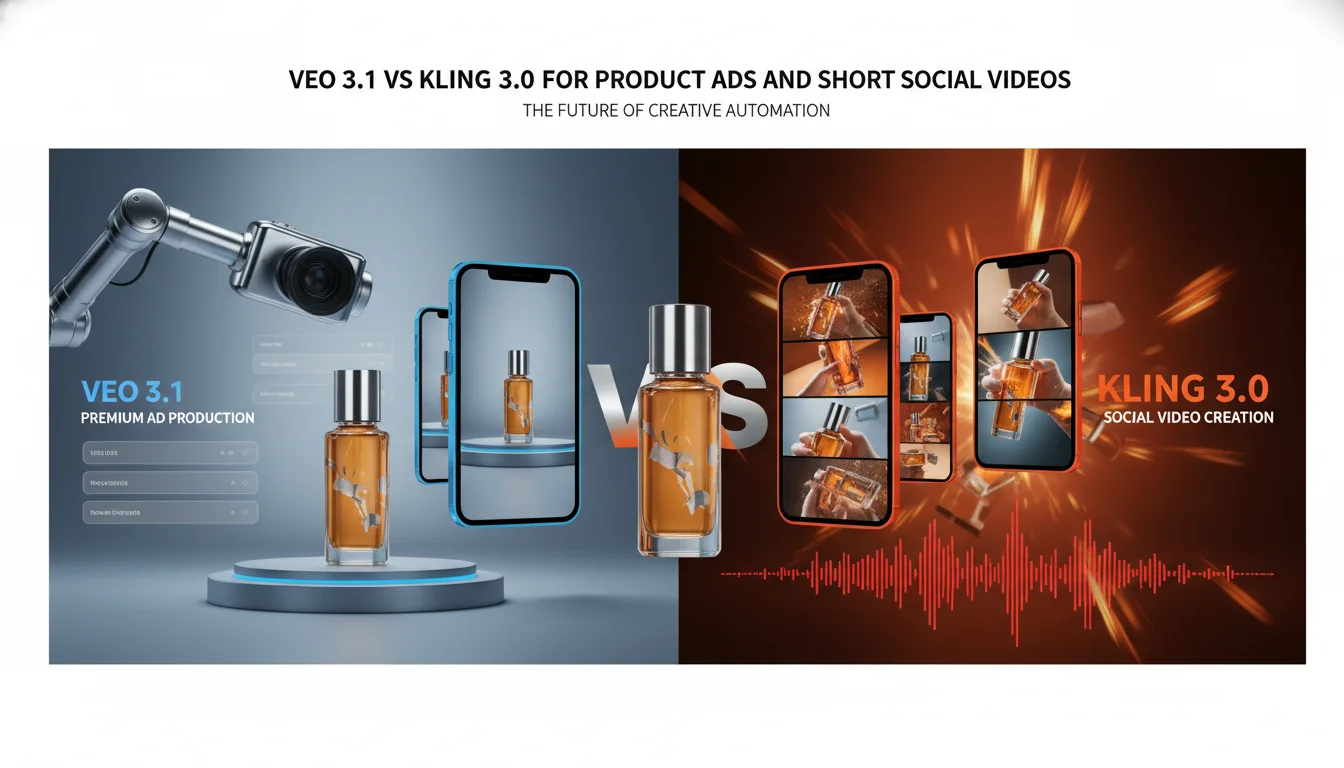
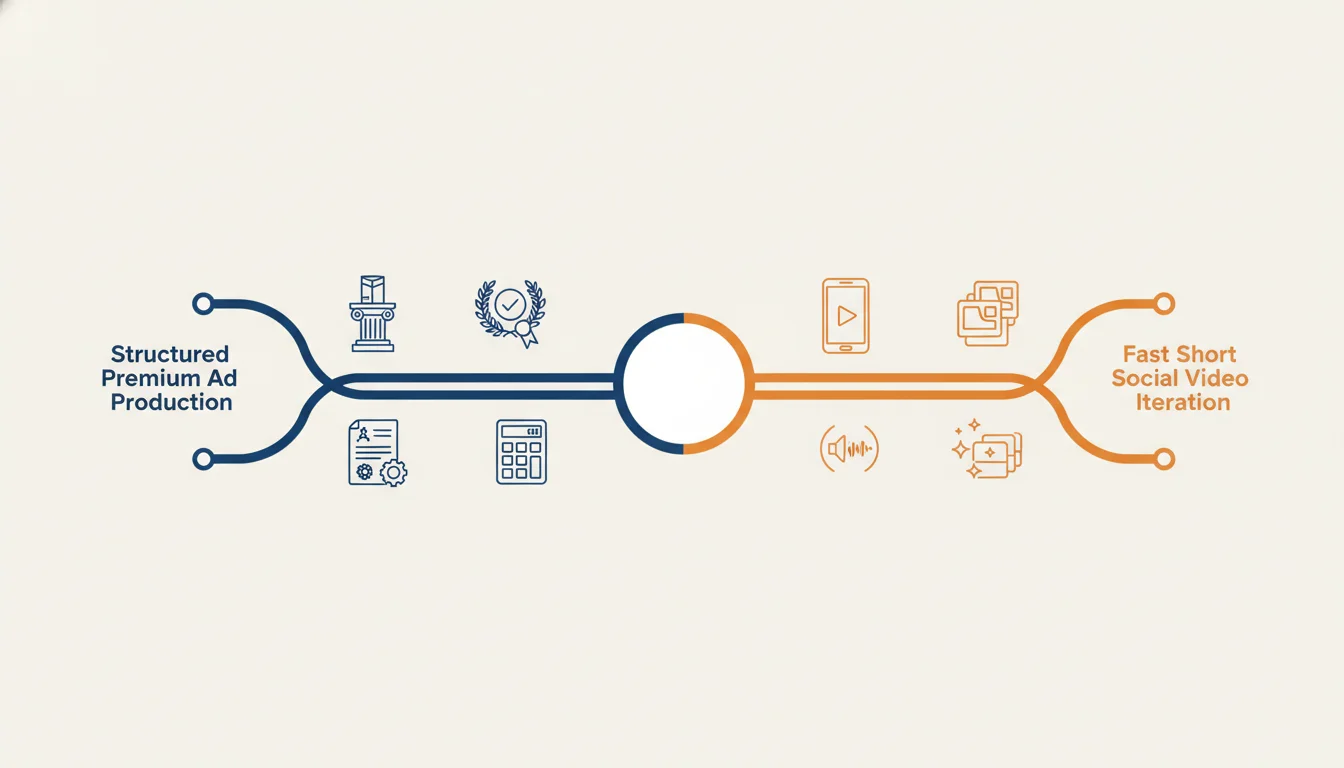
Veo 3.1 is easier to trust when your workflow depends on documented output specs, paid API pricing you can budget around, and a more conservative production path. Kling 3.0 is easier to like when your workflow depends on fast creative iteration, product-image-led promo videos, lip sync, effects, and creator-style social output.
This article stays narrow on purpose. It is not another broad "all AI video models ranked" post. It focuses only on product ads, short social videos, and the buying decisions that matter to marketers, founders, and creative teams right now.
If you want a broader starting point, check . If you want the Google model context first, read . If you want the direct ad and social decision, stay here.
Here is the practical answer as of March 30, 2026:
Choose Veo 3.1 if your team values documented specs, predictable developer pricing, Google-style cinematic output, and a safer path for brand-sensitive ad production.
Choose Kling 3.0 if your team values rapid creative iteration, product-image-led marketing videos, lip sync, effects, and more creator-friendly short-form social workflows.
Choose Veo 3.1 when approval chains, procurement, or technical planning matter more than experimentation speed.
Choose Kling 3.0 when you need more variations, more social-native motion ideas, and more flexible promo formats from the same core assets.
Decision factor
Veo 3.1
Kling 3.0
Best for polished product ads
Stronger
Strong, but more creator-leaning
Best for short social iteration
Good
Stronger
Pricing clarity
Stronger
Weaker across public surfaces
Documented output specs
Stronger
Less transparent in one place
Product-image-led promo workflows
Good
Stronger
Lip sync and effects variety
Limited in public positioning
Stronger
Best fit
Brand teams, developers, structured production
Creators, growth teams, fast ad testing
That is the big picture. The rest of the article explains why.
A marketer does not buy an AI video model the same way an AI enthusiast does.
A hobbyist asks:
which model looks coolest
which one has the loudest launch
which one feels most cinematic
A marketing team asks:
how quickly can we turn one product angle into five ad variants
how easy is it to reuse product images or brand references
how predictable are output length, format, and cost
which tool fits paid social, landing pages, Shorts, Reels, and product launch clips
That is why this comparison should stay workflow-first.
Public product positioning already hints at the split. Veo 3.1 exposes a more documented production surface: clip duration options, aspect ratios, resolutions, frame rate, extend workflows, and explicit paid API pricing. Kling 3.0 exposes a more marketing-facing creative surface: advertising and marketing scenarios, short films, social, lip sync, video effects, elements reference, and product-display video workflows built from product images and simple descriptions.
Those are not small differences. They shape how a team plans production.
Veo 3.1 is strongest when you want ad output to feel deliberate rather than improvised.
Its public workflow is especially useful for teams that care about production guardrails:
clip lengths of 4, 6, or 8 seconds
portrait and landscape support through 9:16 and 16:9
720p, 1080p, and broader 4K support depending on the surface
24 FPS output
extend video workflows
first-and-last-frame generation
reference-led workflows inside the broader Google stack
For ad teams, that matters for a simple reason: short video performance often depends on repeatability more than on surprise.
You usually need to generate versions for:
one hero product shot
one problem-solution angle
one testimonial-style motion concept
one silent autoplay ad cut
one portrait social version
one landscape landing-page version
Veo 3.1 fits that kind of structured output better than a model that mainly sells "creative freedom."
It is also the cleaner choice when finance or engineering needs real cost anchors. Public Gemini API pricing already gives developers a direct budgeting model for Veo 3.1. Standard video with audio is listed at $0.40 per second for 720p/1080p and $0.60 for 4k. Fast video with audio is listed at $0.15 per second for 720p/1080p and $0.35 for 4k.
That pricing does not automatically make Veo cheap. It makes Veo legible.
Kling 3.0 is strongest when your team thinks in variants, hooks, and fast creative remixing.
Its public positioning is unusually explicit for growth and social use cases. The official surfaces directly name:
Advertising & Marketing
Short Films
Social
They also surface a creator-friendly feature mix:
text to video
image to video
video extension
lip sync
video effects
elements reference
audio generation
multi-elements
That combination matters because many ad teams no longer start from a blank prompt. They start from assets:
product packshots
a founder photo
a brand mascot
a few approved claims
a voiceover script
a seasonal offer
Kling 3.0 feels built for that kind of reference-led promo work.
Its public marketing examples are also more commerce-native. One of the clearest official descriptions is the product-display video workflow: product images and simple descriptions become high-quality marketing materials in batches. That is almost a direct summary of what many ecommerce and paid-social teams need every week.
This is where Kling becomes very attractive for short-form output.
You are not only asking, "Can this model generate a pretty clip?"
You are asking:
can it turn product assets into multiple variants quickly
can it support social-native motion ideas without a heavy post workflow
can it create more hooks from the same base creative direction
can it move closer to ad production instead of pure demo generation
Kling 3.0 answers those questions more directly than Veo 3.1 does.
The most useful comparison is not "Which model is smarter?"
It is "Which model reduces friction inside the workflow you already have?"
Workflow question
Veo 3.1
Kling 3.0
I need clear output specs before I start production
Better fit
Less clear
I need per-second API pricing I can model in a spreadsheet
Better fit
Less transparent publicly
I need to turn product images into multiple promo variants quickly
Good
Better fit
I need social-first creative hooks and effect variety
Good
Better fit
I need a safer choice for brand approval and structured teams
Better fit
Good, but less conservative
I need to iterate many short creatives from one campaign brief
Good
Better fit
I need the most obvious lip-sync and effect-led surface
Limited public emphasis
Better fit
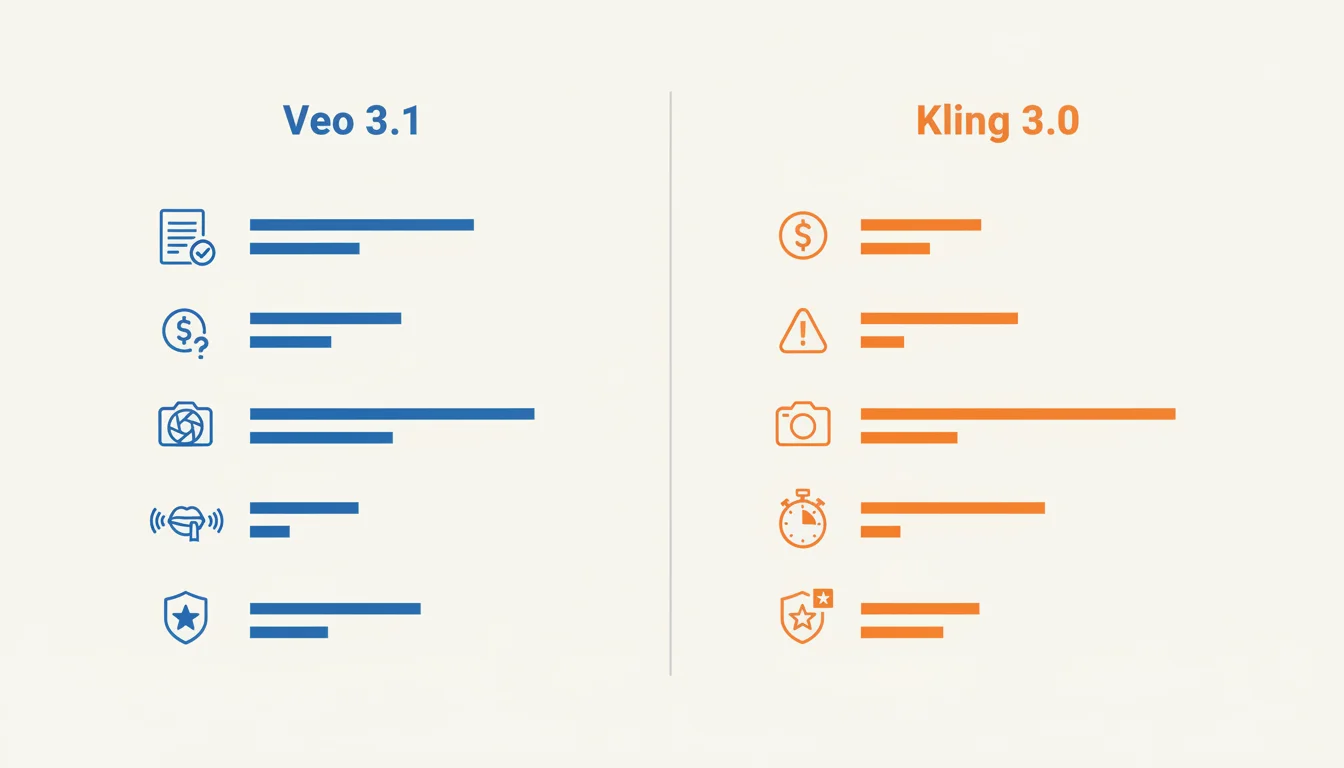
That table explains the difference better than most generic model rankings.
Veo 3.1 wins on structure.
Kling 3.0 wins on velocity.
If your team keeps missing deadlines because creative iteration is too slow, Kling is often the better answer.
If your team keeps getting stuck because stakeholders ask for specs, approved formats, and cost predictability before greenlighting production, Veo is often the better answer.
For finished product ads, Veo 3.1 usually gets the nod.
That does not mean Kling 3.0 is weak for ads. It means Veo 3.1 is easier to defend when the ad has to feel premium, brand-safe, and consistent with a broader production system.
Veo 3.1 is the stronger choice when your product ad workflow looks like this:
define one core campaign angle
build a clean hero visual
lock the opening shot
keep motion restrained and deliberate
generate approved portrait and landscape cuts
hand off to paid media or landing-page teams
This is especially true for:
SaaS product promos
polished app-launch ads
premium ecommerce brand videos
landing-page hero videos
executive or stakeholder-facing campaign concepts
Kling 3.0 becomes more attractive when your product ad workflow looks different:
start from a library of packshots and reference images
produce many fast variations
test hooks for paid social
create creator-style promo cuts
add lip sync, effects, or more obvious motion treatment
optimize for feed-stopping behavior instead of polished restraint
This is especially true for:
DTC product ads
TikTok and Reels ad testing
offer-led promo bursts
short creator-style product explainers
seasonal ecommerce campaigns
The best way to say it is simple:
Veo 3.1 is usually better for the ad you want to approve. Kling 3.0 is usually better for the ad variants you want to test.
For short social videos, Kling 3.0 usually has the more natural fit.
That is partly because its public feature mix looks closer to how short-form teams actually work. Social teams do not only need cinematic beauty. They need:
speed
more variations
quick format pivots
reference-led production
hooks that feel native to the feed
effects or audio behavior that feels less rigid
Kling's public positioning around social, short films, lip sync, effects, and multi-element workflows lines up with that reality very well.
Veo 3.1 is still very usable for short social, especially when the creative direction is cleaner, calmer, or more premium. But it feels more like a structured production tool that can also do social. Kling 3.0 feels more like a social-capable creation system that can also do ads.
That distinction matters when you are briefing teams.
A growth team that ships 20 variants a week usually benefits more from Kling.
A brand studio that ships fewer, more controlled videos usually benefits more from Veo.
This is one of the most important differences in practice.
Veo 3.1 gives you public price anchors that are direct enough for operational planning.
That helps answer real questions such as:
what does a 6-second test batch cost
what is the tradeoff between fast and standard output
when do we move from experimentation to repeat usage
what should engineering expect if we automate this
Kling 3.0 is attractive on the creative side, but its public pricing story is less unified across surfaces. The official pages clearly communicate API availability and capability breadth, but the public cost story is harder to compare one-to-one against Google's published per-second pricing.
That does not make Kling a bad buy.
It makes Kling harder to model in a finance spreadsheet without more manual checking.
For some teams, that barely matters.
For others, it is the deciding factor.
If you need polished hero ads, cleaner stakeholder review, and more predictable planning, Veo 3.1 is usually the safer pick. If you need many fast variants from product images for paid social testing, Kling 3.0 is usually the stronger pick.
Usually yes. Kling 3.0 aligns more naturally with short-form social production because its public feature mix emphasizes social workflows, effects, reference-led generation, and faster creative variation.
Yes. Veo 3.1 has the clearer public planning story because Google already exposes paid API pricing and documented output constraints. Kling 3.0 may still be the better creative choice for some teams, but it is harder to budget from one public pricing view alone.
Often yes. A two-lane setup is practical for teams that need premium ad masters and high-velocity short-form testing at the same time. Veo 3.1 can handle approval-heavy polished output, while Kling 3.0 can handle experimental volume.
For product ads, Veo 3.1 is usually the better choice.
For short social videos, Kling 3.0 is usually the better choice.
That is the cleanest honest answer.
Veo 3.1 wins when you need structured control, pricing clarity, and a safer production story for premium ad work.
Kling 3.0 wins when you need speed, social-native iteration, product-image-led workflows, and more variation from the same creative assets.
If your team is stuck choosing only one, use this shortcut:
pick Veo 3.1 for approval-heavy brand work
pick Kling 3.0 for high-velocity social and performance work
If your team can support two lanes, the strongest operating model is often even simpler:
Veo 3.1 for polished ad masters
Kling 3.0 for short-form testing and creative volume
That is a better decision than chasing hype.
Veo 3.1 vs Kling 3.0 for Product Ads and Short Social Videos
The Short Answer
Why This Comparison Matters More for Marketers Than for AI Hobbyists
What Veo 3.1 Is Actually Good At for Ads and Social
What Kling 3.0 Is Actually Good At for Ads and Social
Veo 3.1 vs Kling 3.0 by Workflow, Not by Hype
Which Model Is Better for Product Ads?
Which Model Is Better for Short Social Videos?
Pricing, Access, and Planning Reality
The Best Choice by Team Type
When Veo 3.1 Is the Wrong Choice
When Kling 3.0 Is the Wrong Choice
A Smarter Decision Framework
FAQ
Is Veo 3.1 better than Kling 3.0 for ecommerce ads?
Is Kling 3.0 better for TikTok, Reels, and Shorts?
Does Veo 3.1 have the clearer public pricing story?