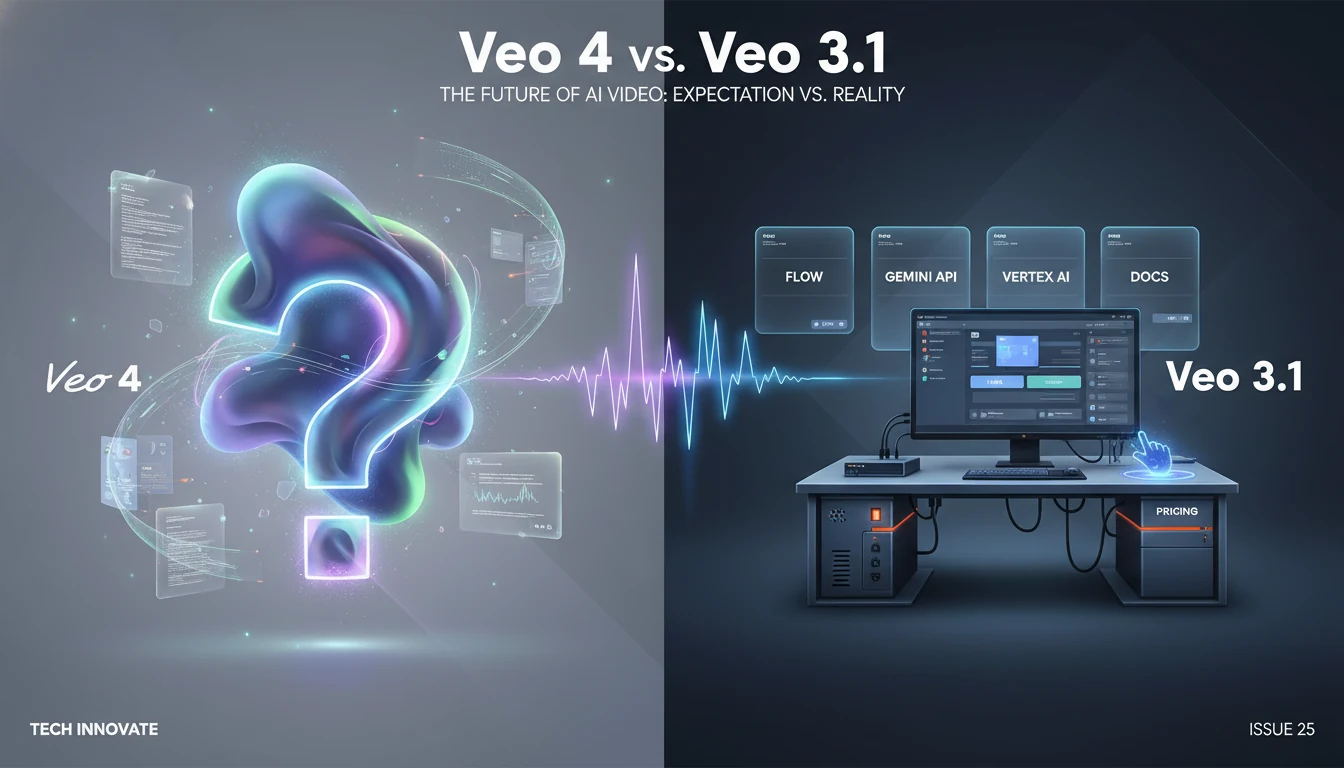
If you search for veo 4 vs veo 3.1, you are usually trying to answer one practical question:
Should you wait for a future Google video model label, or should you build with the public Veo stack that exists today?
That question matters because the naming is easy to confuse.
As of April 1, 2026, Google's public creator stack is centered on Veo 3.1 and the broader Veo 3.1 family across Flow, the Gemini API, Vertex AI, and the Gemini app experience. A clearly documented, generally available public Veo 4 creator release is still not the thing creators can point to today.
That means this comparison needs a stricter frame than most rumor-heavy articles use:
Veo 3.1 is the public, documented workflow you can plan around now.
Veo 4 is still mostly a search-intent label, an expectation bucket, and a future-upgrade question.
The useful decision is not "Which name sounds newer?"
The useful decision is "What can I actually ship this week, and what should I still treat as unknown?"
If you want the release-status context first, read . If you want the detailed public model guide first, read . If you want the direct comparison for creators right now, stay here.
The public Google creator stack has become clearer over the last few months, and that clarity matters.
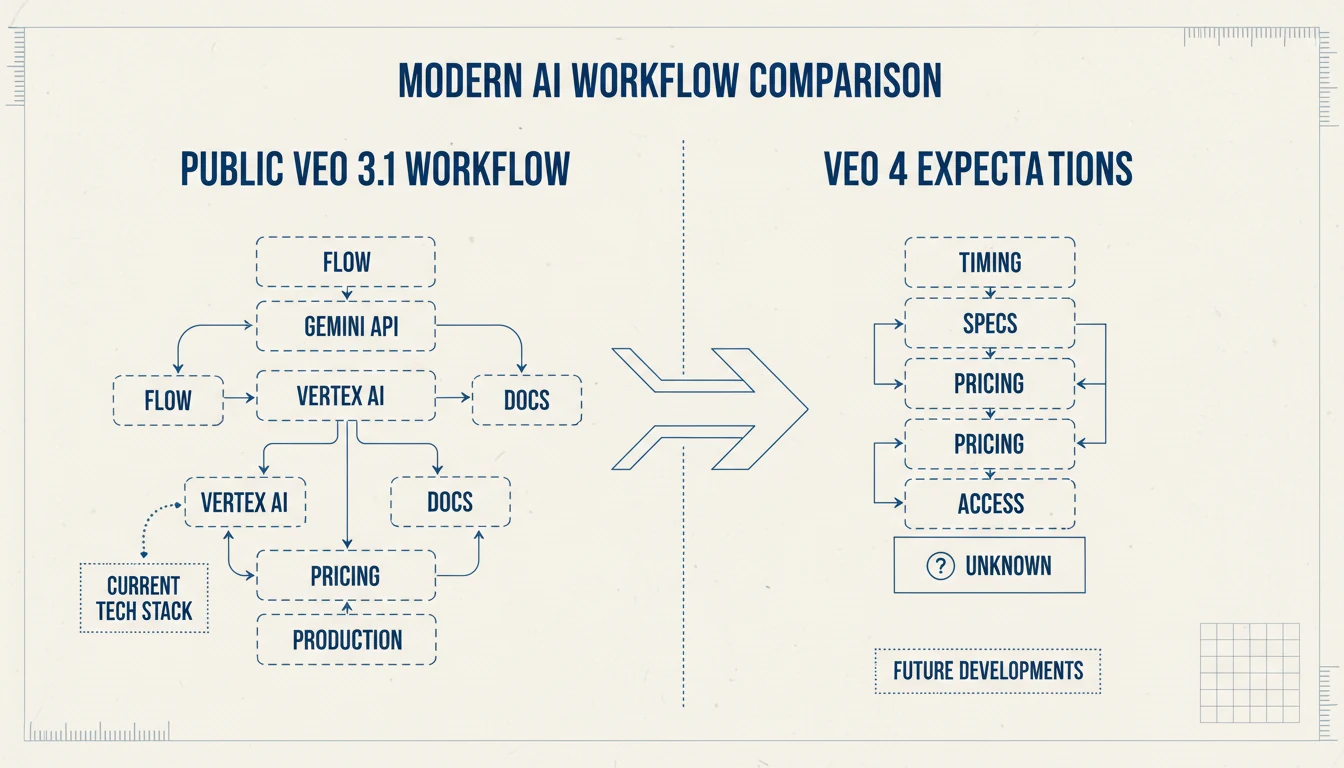
What creators can work with today is not a blank rumor field. It is a real toolchain:
Flow uses Veo 3.1 for higher-quality video output.
Google continues to ship new creative controls around that Veo 3.1 stack instead of switching public creator messaging to a fully public Veo 4 release.
The Gemini and Vertex AI surfaces give creators and teams a documented path for generation and production planning.
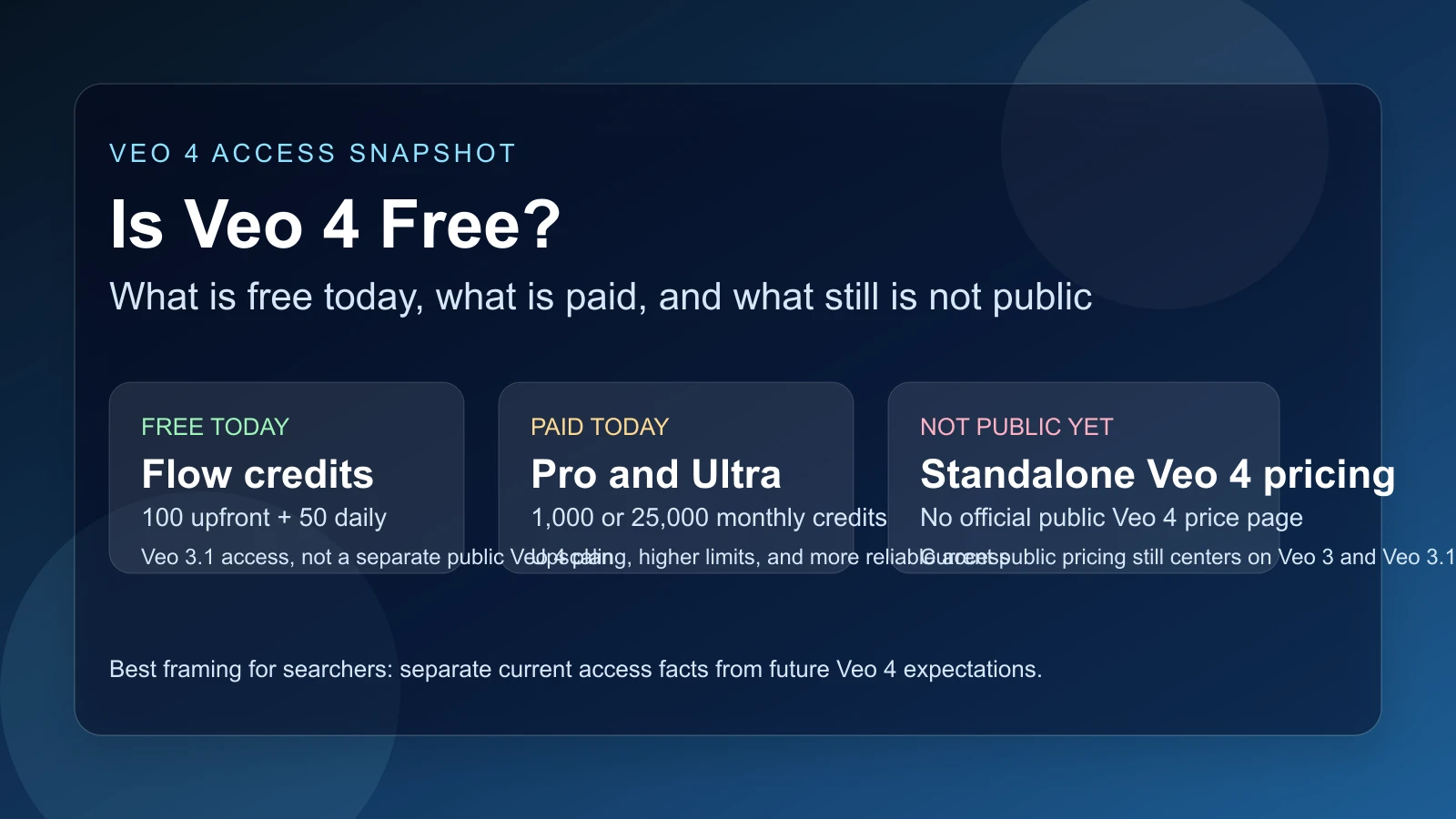
The public pricing story exists around the current Veo 3.1 family, which means teams can model cost and output tradeoffs before they start production.
That last point is a much bigger difference than most comparison posts admit.
Creators do not only compare image quality. They compare:
whether a workflow is public
whether a team can actually access it
whether pricing is legible
whether the output constraints are documented
whether they can move from experiments to repeatable delivery
Veo 3.1 already satisfies those requirements much better than "Veo 4" does today.
But for day-to-day creators, that is not the same as having a stable production surface.
This is why many creators feel confused by the keyword. The query sounds like a direct spec-versus-spec comparison. The current reality is less symmetrical.
Veo 3.1 is the documented product surface.
Veo 4 is the future label people want clarity on.
The safest way to compare Veo 4 and Veo 3.1 today is to separate three things:
what is publicly known
what is a reasonable inference
what is still unknown
Area
Publicly known right now
Reasonable inference
Still unknown
Current Google creator baseline
Veo 3.1 is the public baseline across current creator and developer surfaces
Google is still improving the Veo 3.1 stack rather than replacing it overnight with a fully public Veo 4 rollout
Exact public Veo 4 release timing
Pricing and planning
Veo 3.1 has a public pricing story and plan-level access story
Any future Veo 4 launch would likely need a similarly clear pricing and access story to be useful for teams
Exact Veo 4 pricing, quotas, or tier placement
Workflow maturity
Veo 3.1 is mature enough for real creator workflows today
Veo 4 would need to feel meaningfully different at the workflow level, not only at the model-name level
Exact Veo 4 workflow advantages, if any
Upgrade scope
Search demand clearly expects "more" from a hypothetical Veo 4
A future Veo 4 would need to improve clarity, creator control, and value perception to feel like a true upgrade
Exact spec changes, limits, and creator-facing feature set
This table is not conservative for the sake of caution. It is conservative because creators make expensive mistakes when they treat speculation as product reality.
If your team needs a decision now, the only defensible baseline is the one with public access and public operating constraints.
If you step back from the naming confusion, Veo 3.1 already covers a lot of what creators actually need:
short-form production workflows
image-guided or reference-led generation paths
structured video creation in Flow
developer-facing generation paths for teams that need repeatability
a pricing and access story clear enough for testing and rollout planning
That is why the SEO review matters here. The growth demand is not only for the label veo 4. It is also for more concrete intent terms around ai, free, and video generator.
That tells you something useful:
searchers want usable creation, not only future-model speculation.
The more practical the workflow becomes, the less the average creator cares whether the public answer is branded as "Veo 3.1" or "Veo 4."
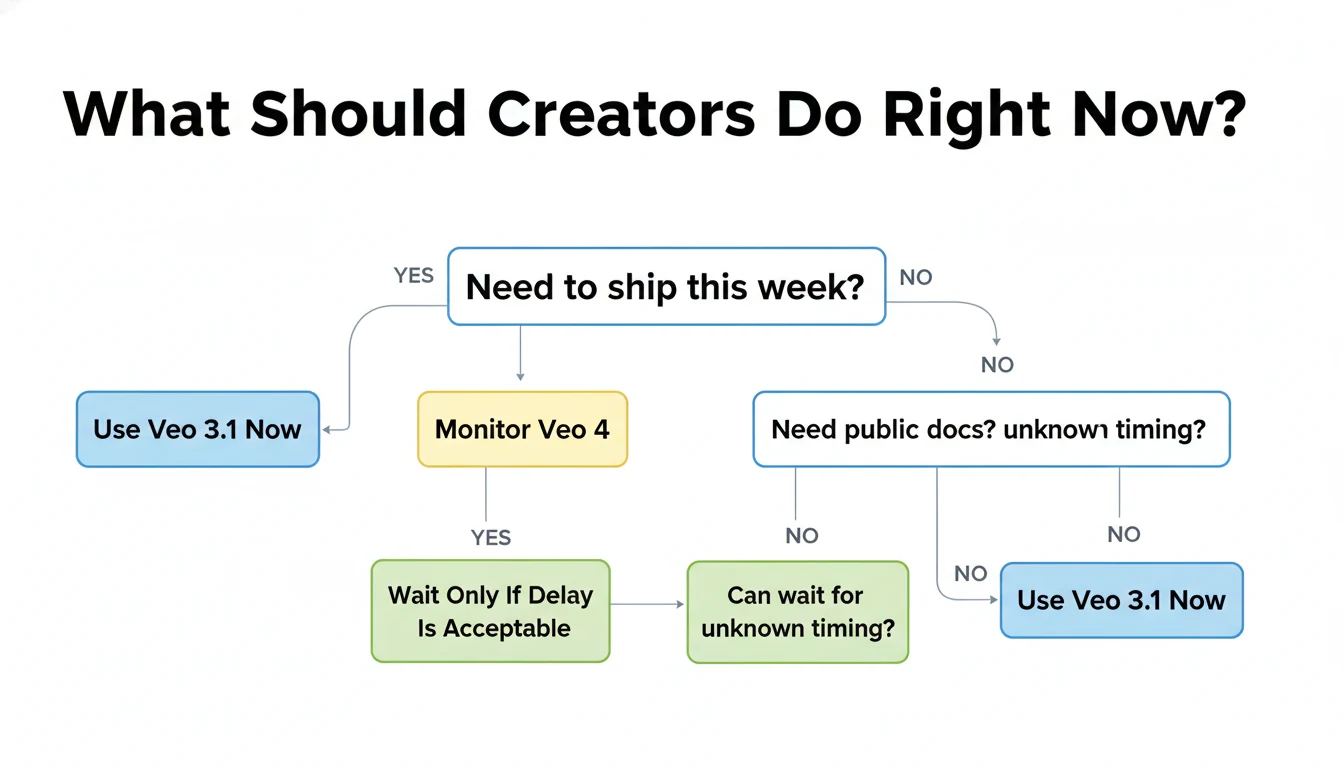
Waiting makes sense only if your workflow depends on a future capability that you cannot reasonably replace with today's public stack.
For everyone else, the practical move is to build with what is public now and treat Veo 4 as an upgrade path to reassess later.
If your goal is...
Best move right now
Learn the current Google video workflow
Use Veo 3.1 now
Build a repeatable team process
Use Veo 3.1 now
Test whether Google-style video fits your content engine
Use Veo 3.1 now
Budget a creator or marketing workflow
Use Veo 3.1 now because public cost and access are clearer
Bet on an undocumented future release
Wait only if your roadmap can absorb delay and ambiguity
This is especially true for:
creators shipping weekly content
marketers testing ad concepts
founders validating landing-page or social video workflows
teams that need a documented path for procurement or development
If you want a faster way to test multiple Google-style video workflows without waiting for a future label to settle, Veo 4 gives you a more practical production workspace for evaluating current creator options.
The biggest difference is not a public image-quality spec. It is workflow certainty. Veo 3.1 is public and usable. Veo 4 is still largely a future-facing expectation.
You should do both, but differently. Use Veo 4 pages for upgrade and comparison intent. Use Veo 3.1 and broader generator pages for current workflow and commercial intent.
If you came here looking for a clean winner between Veo 4 and Veo 3.1, the honest answer is not a flashy one.
Veo 3.1 wins by default today because it is the public workflow you can actually use.
Veo 4 still matters, but it matters as a future release question, a comparison keyword, and an upgrade expectation, not as the safer production choice for creators right now.
So if your goal is to ship, test, learn, and build with Google's current video stack, choose Veo 3.1.
If your goal is to monitor the next real step in Google's creator story, keep watching Veo 4.
Just do not confuse the future label with the present workflow.
Veo 4 vs Veo 3.1: What Is Different for Creators Right Now?
The Short Answer
What Is Actually Public Today
The Real Difference: Public Workflow vs Future Expectation
Veo 3.1 is a creator workflow
Veo 4 is a positioning and upgrade question
Known, Reasonable, and Still Unknown
What Creators Usually Mean When They Ask for Veo 4
What Veo 3.1 Already Covers Well
Where Veo 3.1 Still Feels Incomplete
Should You Wait for Veo 4?
What This Means for SEO and Content Planning
The Most Useful Creator Framework
Choose Veo 3.1 if you need:
Keep watching Veo 4 only if you need:
FAQ
Is Veo 4 publicly available to creators right now?
Is Veo 3.1 still the safest Google video workflow to build on?
Does that mean Veo 4 is not important?
What is the biggest practical difference between Veo 4 and Veo 3.1 right now?