The AI video generation landscape has transformed dramatically in early 2026, with Google's Veo 3.1 commanding an unprecedented 96.4% market share among production users. Yet as competitors like Kling 3.0 and Seedance 2.0 push boundaries with native 4K generation and advanced audio synthesis, the question on every creator's mind is clear: when will Veo 4 arrive, and what will it bring?
This guide maps the current Veo 4 picture through official announcements, competitive signals, and the trajectory of Google's video generation models. Whether you're a content creator planning your 2026 workflow or a technical decision-maker evaluating AI video platforms, understanding what Veo 4 might deliver will help you prepare for the next leap in AI-generated video.
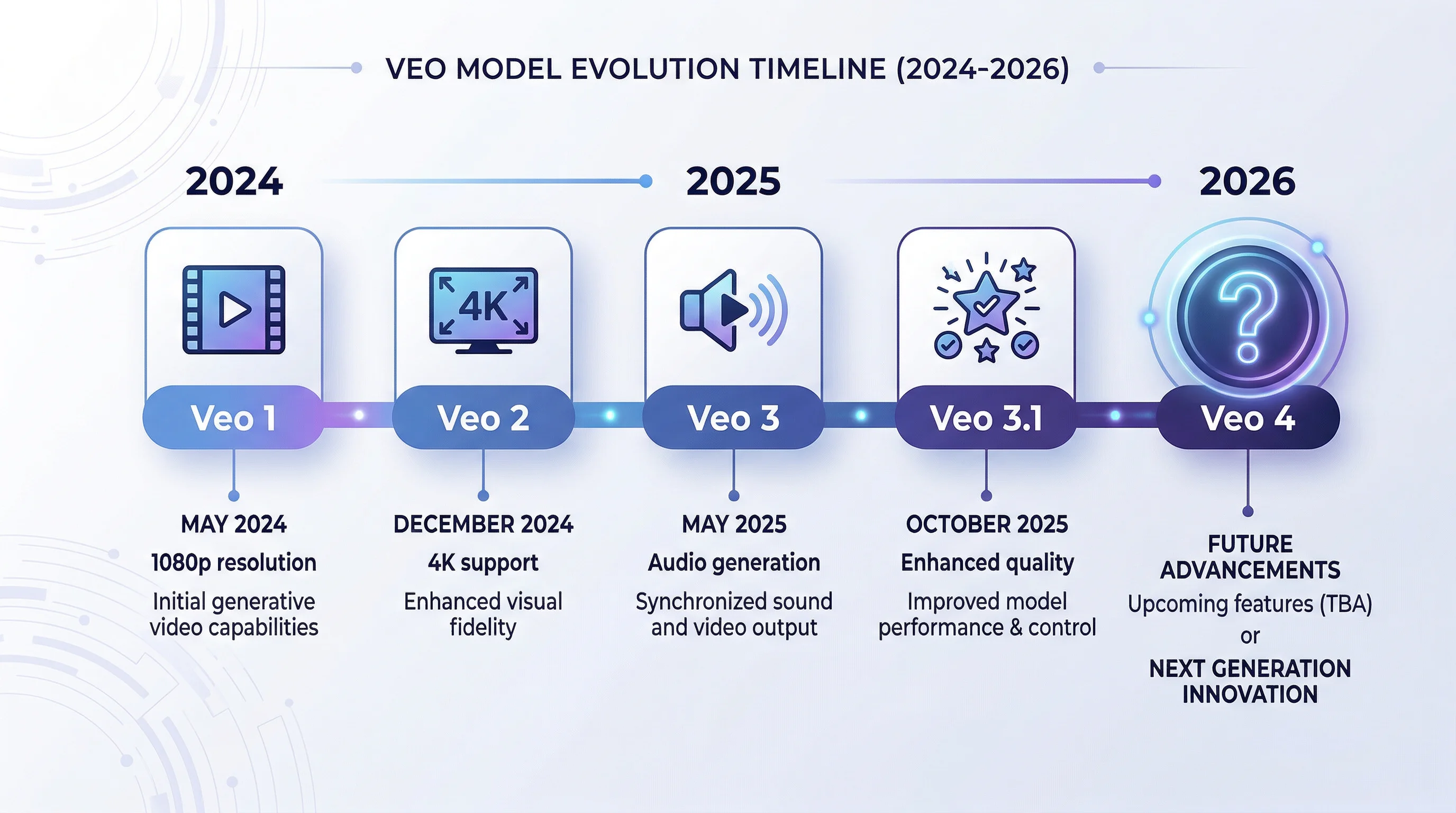
Before examining what Veo 4 might offer, it's essential to understand where the technology stands today. Google released Veo 3.1 in October 2025 as the most advanced iteration of its video generation model, building on Veo 3's May 2025 debut. The model represents a significant milestone: it generates videos at resolutions up to 4K, produces synchronized audio including dialogue and ambient sound, and maintains character consistency across extended sequences.
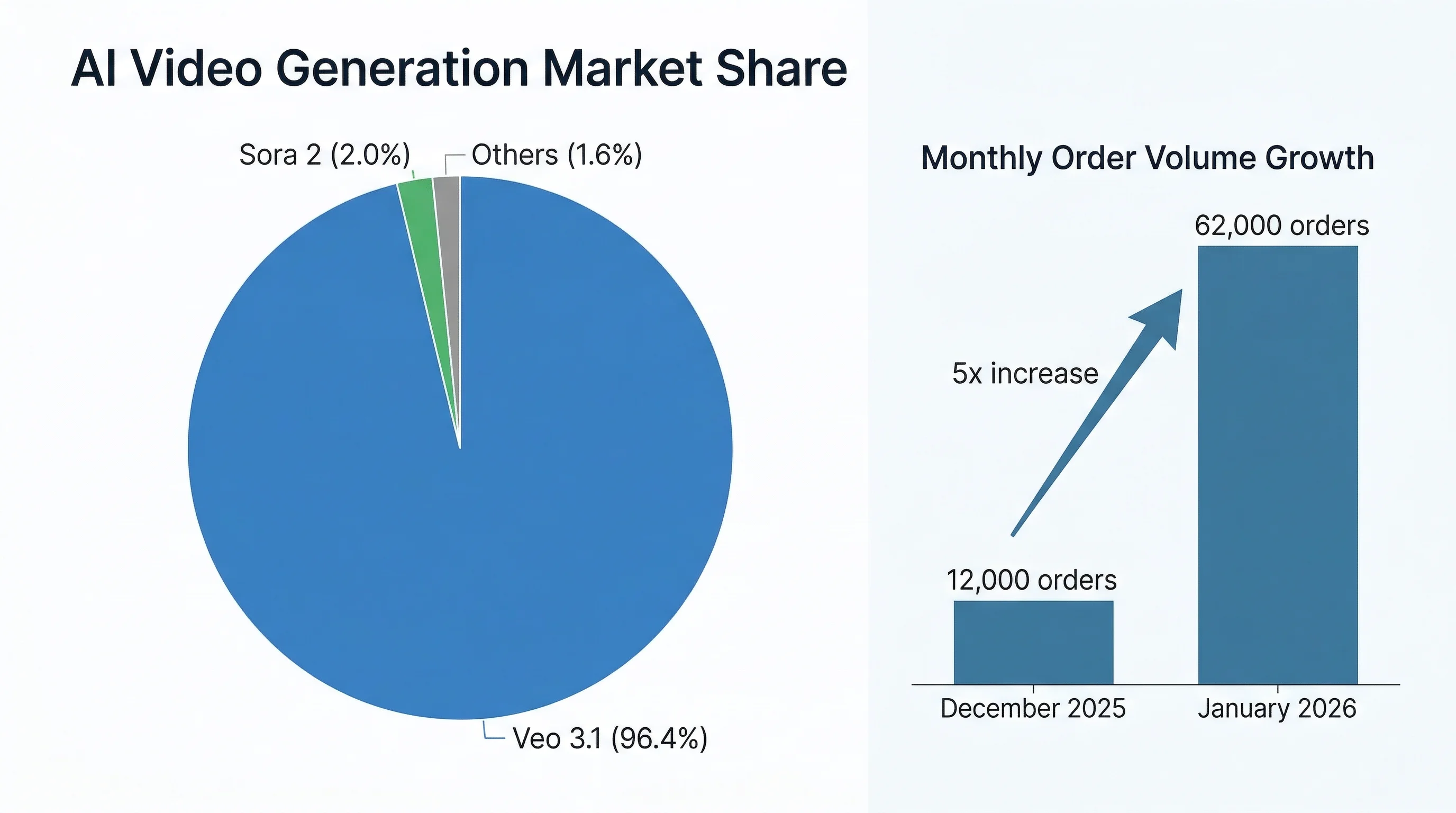
Veo 3.1's market dominance is remarkable. Vivideo's February 2026 data shows the model capturing 96.4% of production video generation orders, with OpenAI's Sora 2 trailing at just 2.0%. Monthly order volume surged from 12,000 in December 2025 to 62,000 in January 2026, a fivefold increase in a single month. This explosive growth reflects not just technical capability but also Google's strategic integration of Veo into Flow, its unified video creation workspace.
However, Veo 3.1's dominance faces mounting pressure. Kling 3.0, released in February 2026, generates natively at 4K resolution with up to 60fps—capabilities that exceed Veo 3.1's current specifications. Seedance 2.0 introduces multimodal control systems that allow creators to reference audio inputs and use @ reference notation for precise compositional control. These competitive advances have sparked intense discussion in creator communities about when Google will respond with Veo 4.
The urgency surrounding Veo 4's release stems from rapid competitive evolution. In February 2026 alone, three major model launches—Kling 3.0, Sora 2 Pro, and Seedance 1.5 Pro—arrived within weeks of each other, each representing fundamentally different approaches to video generation. The structural shifts these models introduced matter more than individual feature announcements because they change what's possible in production workflows.
Consider the resolution ceiling. Kling 3.0 now generates natively at 4K (3840×2160) at up to 60fps, while Veo 3.1 generates at lower resolutions and upscales to 4K through a secondary pass. Veo 3.1's upscale often produces some of the cleanest 4K output in this group with fewer compression artifacts, but the native versus upscaled distinction matters for production pipelines where every processing step adds latency and cost.
Audio generation represents another competitive front. Four of the six major models in February 2026—Kling 3.0, Sora 2, Veo 3.1, and Seedance 1.5 Pro—generate synchronized audio natively, including dialogue, ambient sound, and sound effects. Veo 3.1 operates at professional 48kHz sampling rate, but Seedance 2.0 goes further by accepting audio reference inputs, allowing creators to condition video generation on specific soundscapes or music tracks. This capability eliminates the most time-consuming part of many AI video workflows: post-production audio synchronization.
The creator community's sentiment reflects these competitive dynamics. On Reddit's r/VEO3 forum, users openly discuss whether to maintain Google AI Ultra subscriptions or switch to competing platforms. One February 2026 thread titled "VEO 4 - It's Time" captures the mood: "Aside from some nice feature additions, VEO 3.1 was not a needle moving model upgrade. In some ways it feels worse than 3.0. Last week we saw the release of Kling 3.0 and admittedly it was the first time I seriously considered ending my Google AI Ultra subscription."
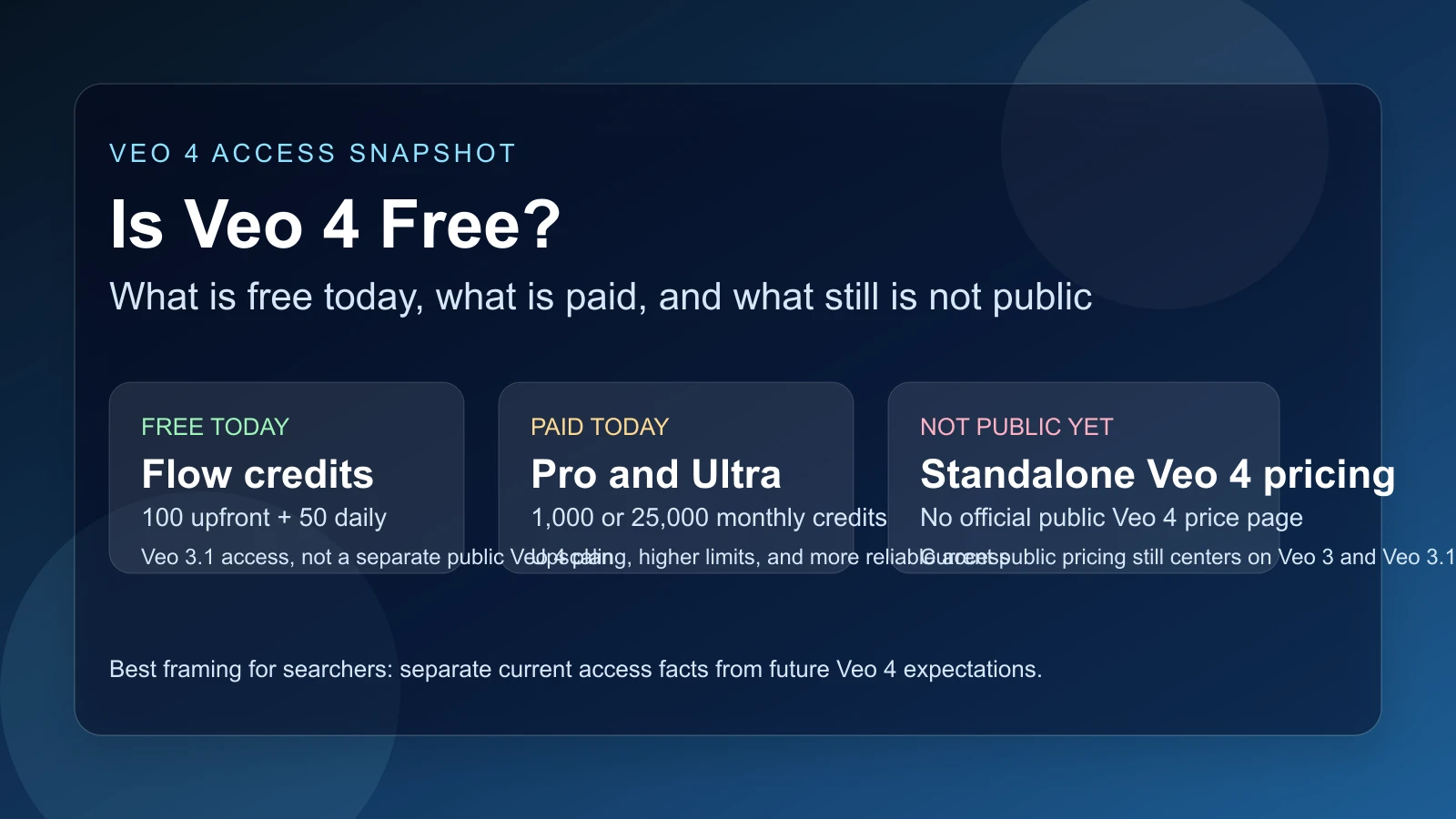
Despite intense speculation, Google has not officially announced Veo 4's release date or detailed specifications. However, several signals suggest development is underway and release may occur within 2026.
Google's February 25, 2026 redesign of Flow provides the clearest signal about Veo's future direction. The update merged Whisk, ImageFX, and Veo capabilities into a unified workspace, with Nano Banana (Google's image generation model) now fully integrated. This architectural consolidation points to Flow becoming the primary distribution channel for Google's next-generation video capabilities.
More significantly, YouTube integration looks increasingly likely. Google has already integrated Veo 3 Fast directly into YouTube Shorts, offering free text-to-video generation with audio for creators worldwide. Direct-to-YouTube publishing from Flow is a logical next step before the end of 2026, with paid tiers likely following the Veo 3 API model through per-second generation charges and a free tier for casual users. This strategic move would position Veo 4 not just as a standalone tool but as infrastructure for YouTube's creator ecosystem.
Another confirmed feature coming to Flow is Gemini-powered prompting, which will allow creators to describe complex scenes in natural language and have the AI automatically break them into multi-shot sequences. This capability addresses one of the most significant pain points in current AI video workflows: translating narrative concepts into technically precise prompts. Google has not tied this feature directly to Veo 4, but the computational complexity of multi-shot sequence planning makes it a strong fit for the next model generation.
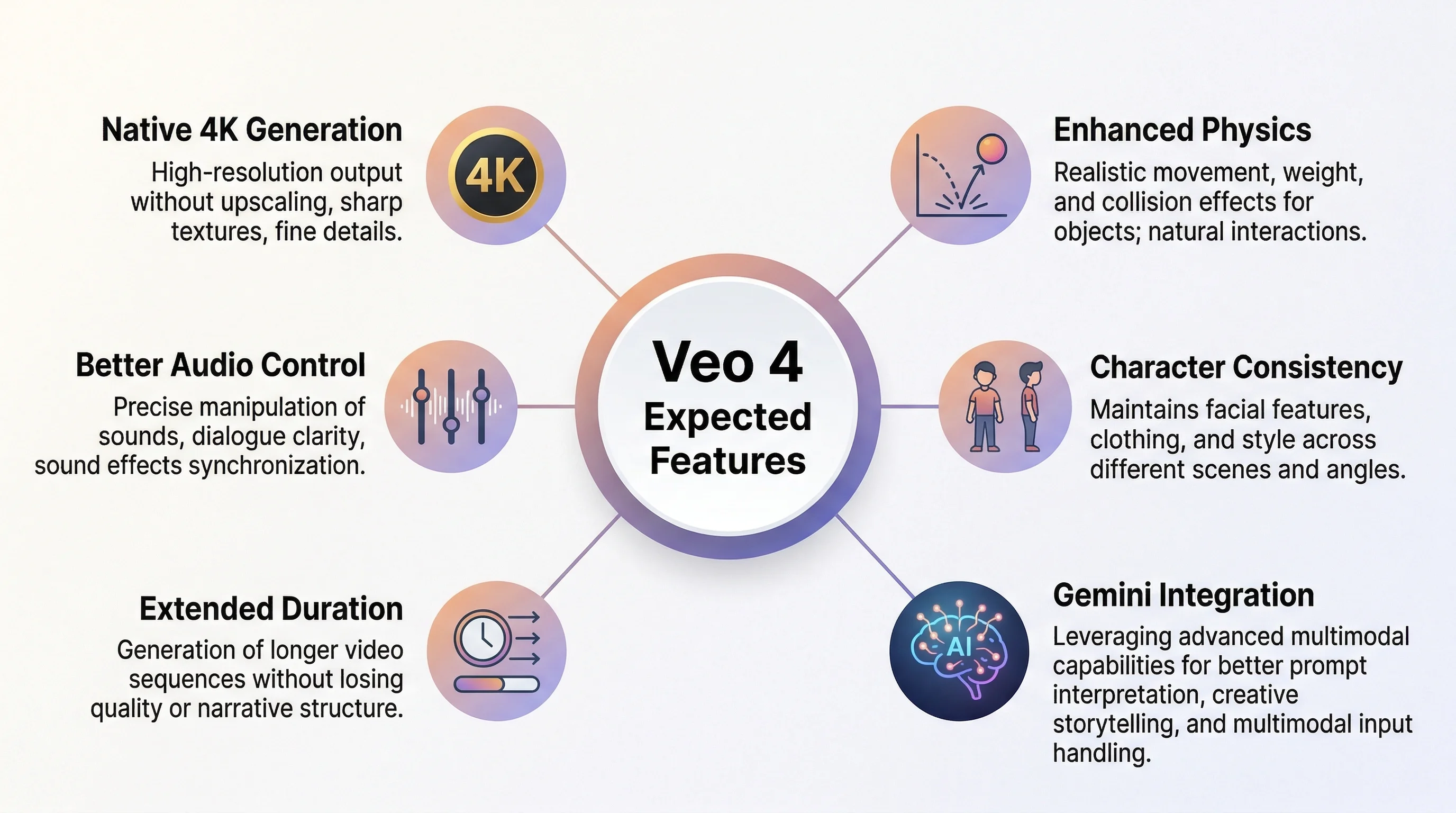
The jump from Veo 2 to Veo 3 to Veo 3.1 points to several likely technical improvements in Veo 4:
Native 4K Generation: Current Veo 3.1 generates at lower resolutions and upscales to 4K. Veo 4 will likely match Kling 3.0's native 4K generation to eliminate the upscaling step and reduce production latency.
Enhanced Motion Quality: Veo 3.1 already delivers crisp textures, accurate shading, and natural motion in everyday scenes, but Sora 2 still leads in physics simulation and object momentum. Veo 4 will need to close this gap to remain competitive for action-oriented content.
Improved Character Consistency: Veo 3.1's "Ingredients to Video" feature allows creators to upload reference images for consistent character appearance across scenes. Complex character interactions still produce mixed results. Veo 4 will likely refine this capability with better understanding of spatial relationships and multi-character dynamics.
Advanced Audio Control: While Veo 3.1 generates professional-grade audio at 48kHz, it lacks Seedance 2.0's audio reference input capability. Veo 4 may introduce audio conditioning to allow creators to specify musical styles, voice characteristics, or ambient soundscapes more precisely.
Extended Duration: Current Veo 3.1 maintains coherence for roughly 60 seconds before motion coherence starts to slip without storyboard guidance. Veo 4 will likely extend this window to support longer-form content without requiring manual scene breaks.
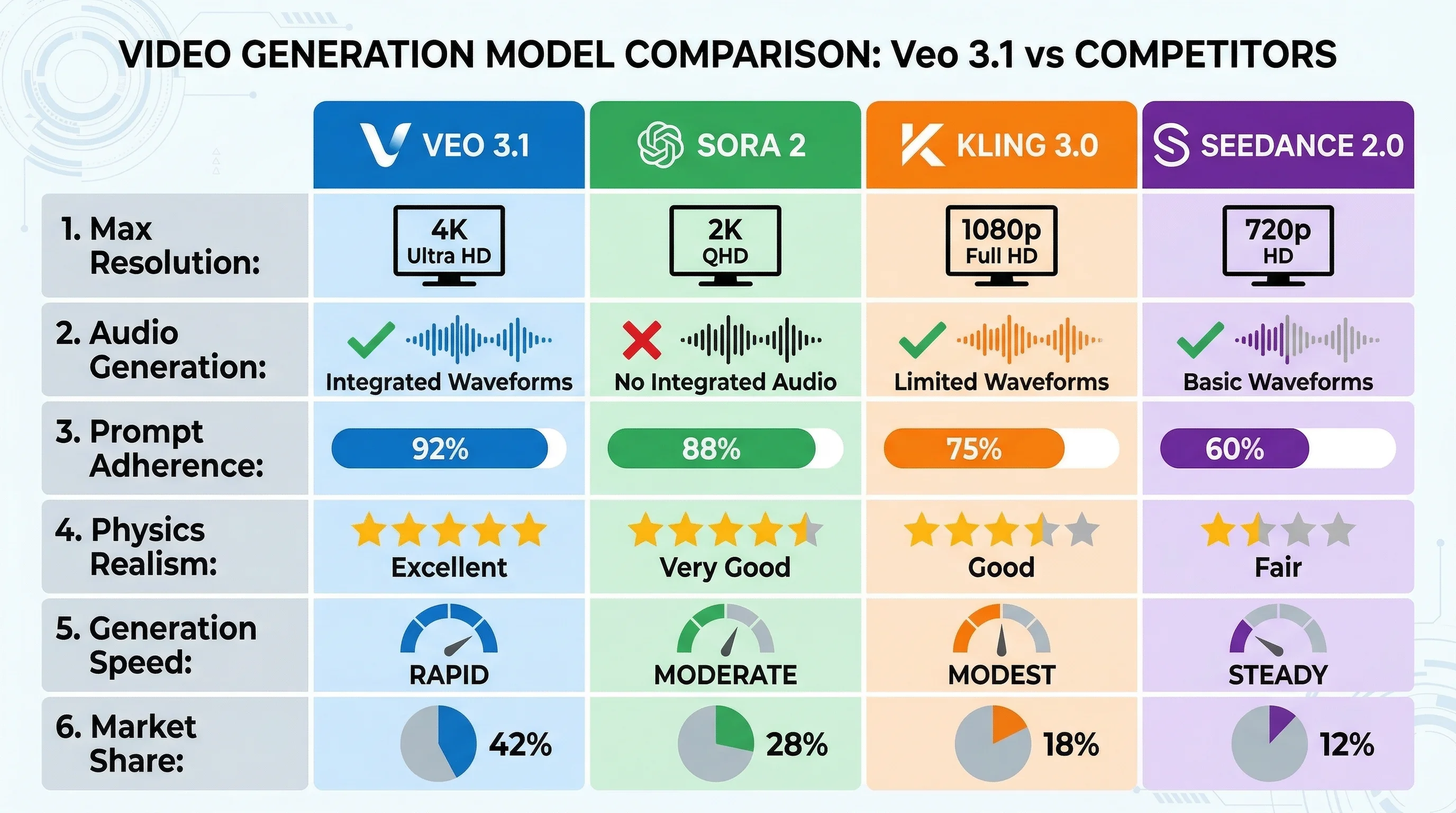
Visual Fidelity: Veo 3.1 leads this group in texture accuracy, shading, and avoiding the "melty borders" that plague other models. When creators zoom in on edges, Veo maintains crisp boundaries better than competitors. This makes it particularly strong for product-focused content, advertisements, and explainer videos where material properties matter.
Prompt Adherence: Testing with specific cinematographic instructions—camera angles, lighting setups, composition requirements—shows Veo 3.1 following prompts accurately 85-90% of the time. On MovieGenBench, Veo 3.1 scored highest on overall preference, consistently outperforming Sora 2, Runway Gen-4, and other competitors in accurately following complex multi-element prompts.
Upscale Quality: While not native 4K, Veo 3.1's upscaling process produces consistent 1080p with fewer compression artifacts and some of the least plasticky 4K upscales among current competitors. Frame rate controls (24/30/60fps) obey prompts more strictly than alternatives.
Editing Capabilities: Veo 3.1 offers some of the strongest mask stability in this category for inpainting and object replacement. Creators can swap props and patch continuity errors without re-rendering entire segments, a significant workflow advantage for iterative production.
Cinematic Feel: Where Veo 3.1 falls behind Sora 2 is in subjective "cinematic feel." The videos are technically excellent but can lack the organic quality that makes Sora 2's output feel hand-crafted. Sora 2 excels at "long, cinematic camera motion with coherent lighting and depth" and "atmosphere: smoke, rain, lens artifacts that sell the shot."
Physics Simulation: Sora 2 remains the benchmark for physical realism. When objects need to move with convincing weight and momentum, Sora 2 is the choice. This gap matters for action sequences, sports content, and any scenario where realistic physics drive viewer engagement.
Compositional Control: Seedance 2.0's @ reference system provides "unmatched compositional control," allowing creators to specify precise spatial arrangements and object relationships through a structured notation system. Veo 3.1's "Ingredients to Video" offers similar functionality but with less precision.
Generation Speed: Kling 3.0 delivers "best value for straightforward generation" with faster turnaround times for simple prompts. Veo 3.1 "generated videos a bit quicker than Sora" but still lags behind Kling for rapid prototyping workflows.
The learning curve for AI video generation extends beyond prompt writing. Veo 3.1's "Ingredients to Video" feature, frame-rate controls, and inpainting tools represent sophisticated capabilities that require practice to master. Creators who develop expertise with these tools now will adapt more quickly when Veo 4 introduces enhanced versions.
Specifically, focus on understanding how Veo 3.1 interprets cinematographic language. Prompts specifying camera angles (Dutch angle, overhead shot, tracking shot), lighting setups (three-point lighting, golden hour, rim light), and composition requirements (rule of thirds, leading lines) reach roughly 85-90% accuracy. This vocabulary will likely carry forward to Veo 4 with expanded capabilities.
Many production teams already use multiple models strategically: Seedance 2.0 for template-based work and remixing, Kling 3.0 for rapid prototyping, and Sora 2 or Veo 3.1 for final high-quality deliverables. This approach hedges against any single model's weaknesses while optimizing for cost and speed.
With Veo 4, this strategy becomes even more relevant. Building logic into your workflow that routes casual content to faster, cheaper models while reserving premium models for hero content can reduce overall costs by 40-60% without noticeably impacting user experience. For example, Veo 3.1 Fast costs $0.15 per second versus Veo 3.1 Standard at $0.40 per second—a pricing structure likely to continue with Veo 4.
Generating 4K video for content displayed at 1080p or lower represents pure waste. The cost difference between Veo 3.1's 1080p ($0.40/sec standard) and 4K ($0.60/sec standard) pricing means a 50% premium for resolution that may never be utilized. As Veo 4 likely introduces native 4K generation, understanding your actual output requirements becomes critical for cost management.
Google's February 2026 Flow redesign merged image generation, video generation, and editing into a single interface. Creators who adopt Flow now will benefit from continuity when Veo 4 launches, as Google will almost certainly debut the new model through this platform first. Flow's "Ingredients to Video" and "Frames to Video" features provide hands-on experience with the multimodal workflows that Veo 4 will likely expand.
While Google will offer direct access through Flow and potentially the Veo API, many creators find value in platforms that aggregate multiple models. Veo 4 offers a comprehensive solution for creators who want to work with cutting-edge AI video technology without managing multiple subscriptions or learning different interfaces. With support for multiple frontier video models and a streamlined workflow, Veo 4 provides a one-stop platform for AI-powered video creation.
Google's historical release cadence and the current competitive pressure make several timeline scenarios plausible:
Optimistic Scenario (Q2 2026): Google announces Veo 4 at Google I/O in May 2026, exactly one year after Veo 3's debut. This timing would align with Google's pattern of major AI announcements at its annual developer conference and would allow Google to recapture momentum before competitors establish stronger market positions.
Moderate Scenario (Q3 2026): Google releases Veo 4 in July-September 2026, following a phased rollout pattern similar to Veo 3.1. Initial access goes to Google AI Ultra subscribers and select partners, with broader availability following in Q4 2026.
Conservative Scenario (Q4 2026 or Q1 2027): Google prioritizes Flow integration and YouTube connectivity over rushing a new model version. Veo 4 arrives in late 2026 or early 2027 as a more substantial architectural upgrade rather than an iterative improvement.
The optimistic or moderate scenarios look most likely. Veo 3.1's 96.4% market share provides Google with breathing room, but that dominance can erode quickly if competitors continue shipping features that Veo lacks. The February 2026 creator discussions about switching platforms show that Google's window for maintaining leadership may be narrower than raw market share numbers imply.
Looking past Veo 4's immediate release, several long-term trends will shape AI video generation through 2026 and beyond:
Vertical Video Dominance: At 43.7% of generation orders and climbing, 9:16 aspect ratio will likely overtake 16:9 within 2026 as short-form social content continues to grow. Veo 4 will need robust vertical video optimization to serve this market.
Mobile Creation: As platforms invest in mobile-optimized generation interfaces, mobile traffic will reach 10-15% of total AI video generation. This shift requires not just responsive interfaces but also models optimized for mobile hardware constraints and on-device processing.
Content Moderation: Regulators globally are increasing scrutiny of AI-generated media. In July 2025, Media Matters documented racist and antisemitic videos generated using Veo 3 appearing on TikTok, highlighting the challenge of preventing misuse. Veo 4 will need more sophisticated content filtering without stifling legitimate creative expression.
Multi-Step Workflows: Image-to-video workflows currently account for 32.6% of orders, a strong signal that creators want fine-grained control over starting visuals. This percentage will likely grow to 40%+ as multi-step AI workflows (image generation → video generation) become more seamless. Veo 4's integration with Nano Banana in Flow positions Google well for this trend.
Veo 4 remains shrouded in speculation, but the competitive dynamics of early 2026 make one thing clear: Google must deliver meaningful improvements to maintain its dominant market position. Native 4K generation, enhanced physics simulation, improved cinematic feel, and advanced audio control represent the minimum viable feature set to match or exceed competitors like Kling 3.0 and Seedance 2.0.
For creators and production teams, the message is equally clear: don't wait for Veo 4 to start building AI video expertise. Master Veo 3.1's current capabilities, develop multi-model workflows, optimize for cost efficiency, and explore Flow's unified workspace. These investments will pay dividends regardless of Veo 4's exact specifications or release timing.
The AI video generation market has reached a inflection point where quality differences between models create winner-take-most dynamics, as evidenced by Veo 3.1's 96.4% market share. Yet that dominance is fragile, built on technical advantages that competitors are rapidly closing. Veo 4's success will depend not just on raw capabilities but on how effectively Google integrates those capabilities into creator workflows through Flow, YouTube, and partner platforms.
Veo 4 exemplifies this integrated approach, bringing together multiple cutting-edge video models in a single, accessible platform. Rather than waiting for any single model to achieve perfection, Veo 4 allows creators to work with the best available technology today while remaining positioned to adopt new models as they emerge. This flexibility—combined with streamlined workflows and professional-grade output—makes platforms like Veo 4 essential tools for creators serious about AI video production.
As we await official announcements, one certainty remains: the AI video generation landscape will look dramatically different by the end of 2026 than it does today. Whether Veo 4 arrives in Q2, Q3, or Q4, creators who build expertise now will be best positioned to leverage whatever capabilities Google ultimately delivers.
Veo 4 Coming Soon: Everything We Know About Google's Next AI Video Model
The Current State: Veo 3.1 Dominance and Growing Competition
Why Veo 4 Matters: The Competitive Landscape in 2026
What We Know About Veo 4: Official Signals and Competitive Direction
Integration with Flow and YouTube
Gemini-Powered Prompting
Expected Technical Improvements
Veo 3.1 vs Competitors: Where Veo 4 Must Improve
Veo 3.1 Strengths
Veo 3.1 Weaknesses
Model Comparison: Veo 3.1 vs Major Competitors
How to Prepare for Veo 4: Practical Steps for Creators
Master Current Veo 3.1 Capabilities
Develop Multi-Model Workflows
Optimize for Resolution Matching
Explore Flow's Unified Workspace
Consider Veo 4 Access Through Integrated Platforms
Timeline Predictions: When Will Veo 4 Actually Launch?