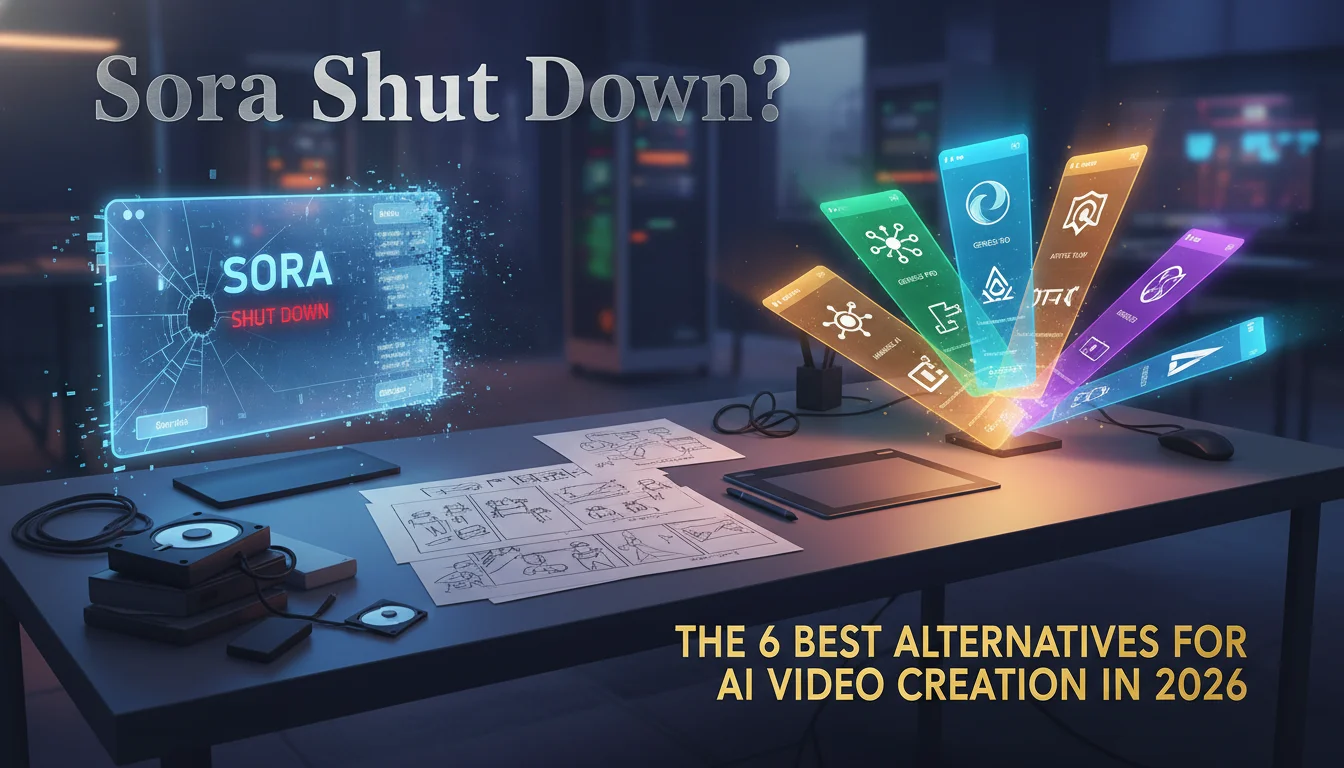
If you searched for "Sora shut down," the short answer is more nuanced than the rumor suggests.
As of March 26, 2026, OpenAI has officially sunset Sora 1 in the United States. The Sora app and Sora 2 workflows remain available in supported regions and plans. The product has clearly changed, the roadmap looks less stable than it did before, and many creators now have a practical reason to line up alternatives even if they have not personally lost access yet.
This is a replacement guide for people who need a dependable AI video workflow now. Sora 1 is gone in the US, regional access is uneven, and other tools already outperform Sora in specific workflows. If you want a broader product view first, our page gives a high-level overview of the creation workflow this article is trying to solve.
Sora Shut Down? The 6 Best Alternatives for AI Video Creation in 2026 | Blog
Veo 4
Teams that do not want to bet on a single vendor
One workspace for multiple top AI video models, text-to-video, image-to-video, and production-friendly workflows
It is a workflow decision, not a single-model cult favorite
Google Veo 3.1
Cinematic output and synced audio
Strong visual quality, reference-guided generation, and native audio workflows
Access and pricing depend on the Google stack
Runway Gen-4
Reference-based control and consistency
Strong character, object, and location consistency across shots
Best results usually depend on having reference inputs ready
MiniMax Hailuo 02
Fast-moving scenes and value-focused experimentation
Strong motion energy, competitive realism, and improving physics
Product surface and regional familiarity vary by market
Pika
Social-first content and creative effects
Fast ideation, remix-friendly tools, and creator-oriented effects
Less of a high-end cinematic production platform
Luma Ray2
Prompt-driven realism and story shots
Strong motion quality and flexible text, image, and video input workflows
Not every team will prefer its creative controls over Runway or Google
If you are replacing Sora for a business, not just for personal experiments, Veo 4 is the most practical starting point because it reduces the biggest risk behind the current Sora situation: workflow dependence on one vendor.
I did not rank these tools by hype. I ranked them by replacement value.
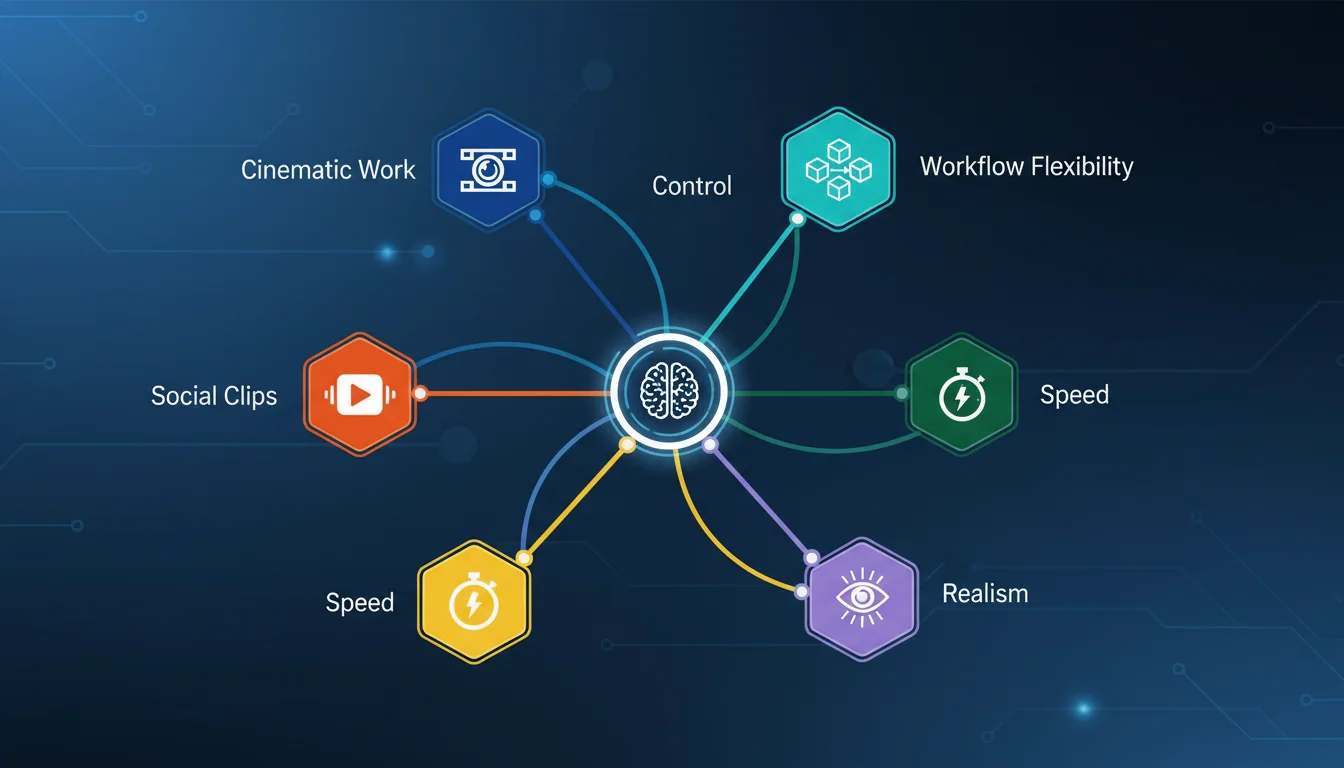
The criteria that matter most after a product disruption are:
Workflow continuity: Can you keep creating without rebuilding your entire process?
Control: Can you guide results with references, settings, or structured prompts?
Output fit: Is the tool best for cinematic ads, social clips, demos, or story scenes?
Reliability: Does the product feel stable enough to use repeatedly, not just test once?
Strategic flexibility: Are you locking yourself into one model again, or buying optionality?
That last point is the one many "best Sora alternatives" lists miss. If your frustration with Sora is really about uncertainty, replacing one single-vendor dependency with another is only a partial solution.
The strongest replacement for most teams is not "the tool that looks most like Sora." It is the tool that makes your workflow more resilient than it was before.
That is why Veo 4 ranks first here. Instead of forcing you to commit to one model roadmap, it gives you a single AI creation workspace built around modern video generation workflows, including text-to-video, image-to-video, and access to multiple frontier model paths. That matters if your real pain point is not just output quality, but instability in access, features, or product direction.
Why Veo 4 works especially well as a Sora replacement:
It fits teams that need one place to create, iterate, and compare outputs.
It reduces dependence on a single model vendor.
It supports the kinds of workflows Sora users typically care about: creative ideation, visual storytelling, marketing assets, and fast iteration.
It is practical for mixed use cases, not only one niche.
Best for:
Marketers producing campaign videos and variations
Founders and small teams that do not want fragmented subscriptions
Creators who want optionality across model types
Teams replacing Sora because of product uncertainty, not only because of raw output quality
Main tradeoff:
If your entire identity is tied to one specific model aesthetic, a multi-model workspace can feel less romantic than using a single flagship tool directly
If your goal is to replace Sora with something more durable, not just something newer, Veo 4 is the most practical choice in this list.
If what you liked about Sora was the feeling of polished, cinematic output, Google Veo 3.1 is one of the clearest upgrades available right now.
Its biggest strengths are not just visual fidelity. Veo 3.1 is also compelling because it combines strong prompt interpretation, reference-guided generation, vertical output support, and native audio workflows in one model family. That makes it particularly attractive for ad creatives, short films, product demos, and premium social content. If you want a deeper breakdown of its strengths and tradeoffs, see our complete Veo 3.1 guide.
Why it stands out:
Strong cinematic look with professional-feeling motion and lighting
Native audio support, which reduces rough-cut friction
Reference image workflows that help maintain subject direction
A better fit than Sora for teams already operating inside Google's broader ecosystem
Best for:
Creators making polished marketing or brand videos
Teams that want synced audio earlier in the process
Users who care about cinematic finish more than experimental effects
Main tradeoff:
Access, pricing, and workflow feel are heavily shaped by Google's product ecosystem rather than a lightweight creator-first app model
Runway remains one of the strongest answers if your replacement question is really about control.
Sora attracted many users because it felt like a general-purpose creative engine. Runway is different. It is often at its best when you already know the shot you want, have a reference mindset, and care about keeping characters, locations, or objects coherent across iterations. For teams doing storyboards, campaigns, branded sequences, or repeatable creative pipelines, that is a major advantage.
Why it stands out:
Strong consistency across characters, scenes, and objects
Better fit for structured, shot-oriented workflows
Mature product surface for teams already used to creative iteration
Useful when your problem is less "make something magical" and more "make this idea usable"
Best for:
Creative teams with existing frames, stills, or look references
Branded storytelling and storyboard-driven production
Users who value control over surprise
Main tradeoff:
It usually performs best when you bring more direction to the table, so it can feel less casual or effortless than creator-first tools
MiniMax Hailuo 02 is one of the most interesting alternatives for people who want motion that feels punchier and more immediately dynamic without paying enterprise-level costs for every iteration.
The reason to consider Hailuo is not that it perfectly replicates Sora. It does not. The reason is that it has become a credible option for teams that prioritize movement, speed, and practical experimentation, especially when they are testing multiple ideas before committing to a final direction. If you are comparing that kind of fast-moving tool choice against a more cinematic model path, our Veo 3.1 vs Seedance 2 comparison is a useful reference point for how production tradeoffs show up in practice.
Why it stands out:
Strong motion energy for action-heavy or visually active scenes
Competitive realism relative to cost and speed expectations
Improving physics and artifact handling compared with earlier generations
Useful as a high-iteration option inside a broader workflow
Best for:
Teams testing multiple concepts quickly
Creators who want a strong cost-to-output ratio
Projects where motion intensity matters more than luxury polish
Main tradeoff:
Brand familiarity, onboarding comfort, and ecosystem depth still trail the biggest Western consumer-facing platforms
Pika is not the most direct Sora replacement, but it is one of the smartest if your real use case is short-form content.
Many people who started with Sora were not making cinematic product films every day. They were making quick, weird, scroll-stopping clips, visual jokes, stylized promos, or fast concept pieces. That is exactly where Pika still deserves attention. Its product direction has leaned into creator-friendly effects, remix behavior, and faster concept generation rather than pure "film tool" positioning.
Why it stands out:
Strong fit for social video culture
Fast idea-to-output loop
Creator-friendly feature set for effects, twists, and playful transformations
Easier recommendation for solo creators than for formal production teams
Best for:
TikTok, Reels, Shorts, and social-native experiments
Creators who want fast iteration and standout effects
People replacing Sora for fun, hooks, and concept testing rather than polished client work
Main tradeoff:
It is less compelling than Veo, Runway, or Luma for teams optimizing around high-end cinematic consistency
Luma Ray2 is the alternative I would shortlist for creators who care most about believable motion and scene evolution from a strong text prompt or visual starting point.
Luma has continued to matter because it treats AI video as a storytelling tool, not only a template engine. Ray2 is especially interesting for creators who want realism, atmosphere, and a sense that the shot is developing over time rather than simply animating in place.
Why it stands out:
Strong prompt-driven scene generation
Flexible text, image, and video input paths
Convincing motion for narrative or cinematic setups
Good fit for creative teams that want realism without fully sacrificing speed
Best for:
Story-driven visual content
Concept films, branded scenes, and mood-first videos
Creators who want a bridge between raw prompting and directed output
Main tradeoff:
Some teams will still prefer Runway for tighter control or Veo for audio-integrated premium workflows
Most articles on this topic assume the only question is "Which model is best?"
That is the wrong question after a product disruption.
The better question is this: what setup gives me the least operational pain if the market shifts again in three months?
That is where Veo 4 has the clearest advantage. It is not only another model to test. It is a practical replacement path for teams that want:
one platform instead of scattered subscriptions,
multiple creation modes instead of one narrow workflow,
faster switching between model strengths,
less exposure to abrupt single-product changes.
If Sora made you realize you do not want to build your process around one unstable dependency, that is exactly the kind of lesson Veo 4 is built for. If you want the product-side context behind that positioning, our earlier Veo 4 roadmap article explains why we frame the category around workflow resilience, not just model launches.
No. As of March 26, 2026, Sora 1 has officially been sunset in the US, while the Sora app and Sora 2 workflows remain available in supported regions and plans. Sora has changed sharply, but it is not accurate to describe it as universally shut down everywhere.
For most people, the closest practical replacement is not one single tool. It is Veo 4 as a workflow hub, because it gives you flexibility across video creation paths instead of forcing you into one vendor's roadmap.
Google Veo 3.1 is the strongest fit if you care most about cinematic polish, reference-guided generation, and native audio workflows. Runway Gen-4 is also excellent if your team works from references and shot plans.
Pika is the best fit for fast, scroll-stopping creator content. Hailuo 02 is also worth testing if you want stronger motion energy without overcomplicating the workflow.
If your current access still works and it fits your workflow, you do not need a dramatic exit. But you should absolutely have a backup. The real lesson from the last few weeks is not that every user must quit today. It is that serious creators should not depend on a single video product with a moving roadmap.