The AI video market has moved past the stage where "looks impressive in a
demo" is enough. In 2026, creators, marketers, product teams, and studios are
asking harder questions: Which model holds motion together under stress? Which
one follows complex prompts instead of improvising? Which one handles sound as
part of the scene rather than as an afterthought? And, maybe most importantly,
which one is reliable enough to fit into a real workflow?
That is why the comparison between Happy Horse 1.0 and Veo 3.1 matters.
On the surface, this looks like a straightforward showdown between a
fast-rising open-style challenger and one of the most polished proprietary
video systems in the market. In reality, it is a comparison between two very
different value propositions.
Happy Horse 1.0 became widely discussed because it surfaced with unusually
strong public benchmark momentum, especially in blind preference-style
evaluation contexts. It was framed as a model with a unified multimodal
architecture, native audio-video generation, fast inference, and strong
image-to-video performance. But much of the technical story around it still
sits in a gray zone where some claims are repeated widely while public
verification remains incomplete.
Veo 3.1, by contrast, is not mysterious at all. Its value is less about shock
factor and more about execution quality. Google's public materials consistently
position it around better prompt adherence, stronger audiovisual quality,
richer controls, production availability, and an ecosystem that already
connects to broader creator and developer workflows.
So the real question is not simply, "Which model is stronger on paper?" The
real question is: Which one is better for your actual use case today?
If you want the shortest possible verdict, here it is:
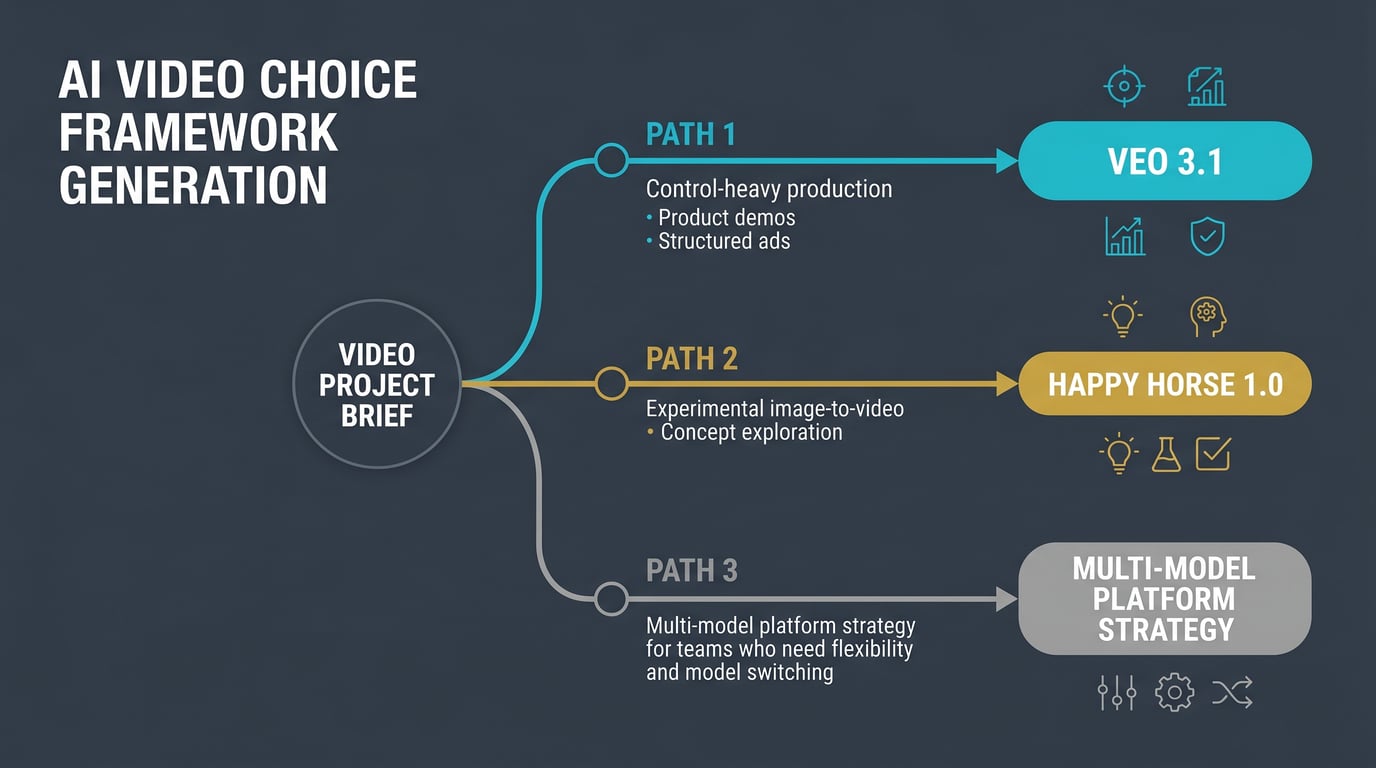
Choose Happy Horse 1.0 for experimentation, leaderboard curiosity, and
potentially exceptional image-to-video upside if you have trustworthy access
to it and you are comfortable with ecosystem uncertainty.
Choose Veo 3.1 for production work, prompt fidelity, dependable access,
and more mature creator workflows, especially when audio, control, and
repeatability matter.
Choose a platform layer rather than betting your entire workflow on one
model if your team needs to compare outputs, switch models by use case, and
avoid lock-in. Veo 4 offers exactly
that kind of one-stop AI creation workflow by integrating multiple leading
video and image models behind a much simpler user experience.
Before comparing quality, it helps to separate signal from hype.
The strongest reason Happy Horse 1.0 exploded into discussion is not a
marketing page. It is the fact that it appeared in blind-comparison discourse
as a model that performed unusually well in text-to-video and image-to-video
preference settings. That matters because blind voting removes some of the
branding bias that usually distorts AI model conversations. If users prefer
outputs without knowing which model created them, that is meaningful.
At the same time, the public story around Happy Horse 1.0 is unusually messy.
Across public pages, mirrors, and blog coverage, several technical claims
recur:
a 15B-parameter model
a 40-layer unified Transformer
joint video and audio generation
8-step distilled inference
around 1080p generation in roughly 38 seconds on H100-class hardware
multilingual lip-sync support
open-source or open-weight positioning
The problem is not that these claims are impossible. The problem is that they
have not all been equally verifiable in the public web snapshots and user
reports checked during research. Multiple writers have pointed out a gap
between the "fully open" narrative and the practical reality of public docs,
weights, repository access, or stable licensing visibility. That does not prove
the claims are false. But it does mean any serious buyer should treat Happy
Horse 1.0 as a model with high performance promise and partial
verification, not as a fully settled infrastructure choice.
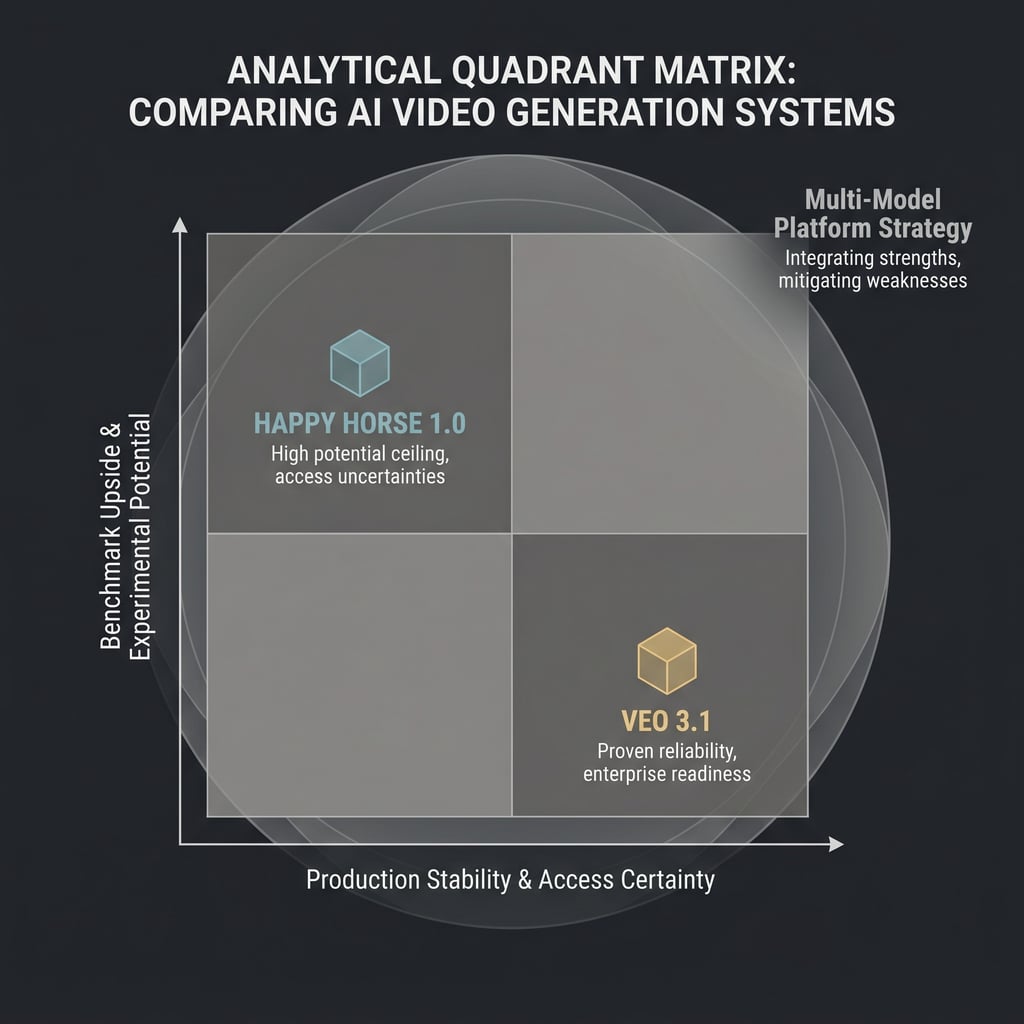
A model can be brilliant in a blind arena and still be a risky production
dependency. If documentation is inconsistent, distribution is fragmented, or
access paths are unclear, the operational cost rises fast. Teams do not just
buy visual quality. They buy repeatability, tooling, access stability,
compliance confidence, and a path to scale.
That is the first major difference between Happy Horse 1.0 and Veo 3.1.
A lot of AI video models look good when prompts are simple. The real stress
test comes when the prompt contains multiple simultaneous constraints: camera
movement, subject action, environment, lighting, emotional tone, sound cues,
and continuity expectations. Veo 3.1 is consistently positioned as stronger
than earlier Veo versions in this exact area.
That sounds abstract until you use it. Better prompt adherence means fewer
wasted generations. It means the model is more likely to keep the camera low
when you ask for a low-angle tracking shot, more likely to preserve the
lighting logic you specified, and more likely to execute multiple instructions
at the same time instead of silently dropping half of them.
For professionals, that is not a luxury feature. That is a cost feature.
Veo 3.1's audio story is also easier to trust. Public guidance frames audio not
as a gimmick, but as part of the model's core creative control. This includes
ambience, effects, and prompt-directed sound design. That makes it especially
useful for short ads, product reveals, social clips, talking scenes, and
creator content where the soundtrack is part of the first impression.
Happy Horse 1.0 is frequently described as a native joint audio-video model as
well. The difference is not simply capability on paper. The difference is that
Veo 3.1's broader productization gives users a clearer idea of how they can
actually use that capability in real workflows.
Veo 3.1 benefits from something many benchmark-driven conversations ignore:
workflow gravity.
A model is not just an output engine. It sits inside access layers, developer
tools, prompt guides, aspect-ratio options, editing workflows, and deployment
paths. Veo 3.1 is part of a more mature ecosystem where creators can think in
terms of iteration rather than isolated demo clips.
This matters even more than raw quality when teams move from "testing AI video"
to "shipping campaigns every week."
Even if Happy Horse 1.0 remains visually competitive, Veo 3.1 currently has
the stronger trust profile for teams that need procurement clarity, predictable
access, watermarking expectations, and a lower chance of suddenly losing a core
workflow because a public release path changed.
That trust premium is real. It often outweighs a marginal quality difference.
If a model earns strong performance in blind preference environments, it
usually means ordinary viewers like the outputs without needing technical
explanation. That is powerful. It suggests the model may be doing something
right in composition, motion readability, style cohesion, or image-to-video
transformation that lands immediately with human viewers.
The most interesting part of the Happy Horse story is not just text-to-video.
It is image-to-video. When a model becomes known for strong visual continuity
from a source image, it starts attracting serious creative teams because
image-led workflows are often more controllable than pure text generation.
If you already have:
key art
product renders
character sheets
storyboard frames
moodboards
then a strong image-to-video model can sometimes be more useful than a general
text-to-video winner.
The repeated public claims around 8-step distilled inference and relatively
fast high-resolution generation are not trivial. If those claims hold
consistently in accessible implementations, Happy Horse 1.0 could become
attractive not only as a quality model, but as a throughput model.
That would matter for agencies, growth teams, and experimentation-heavy
environments where the bottleneck is not imagination but iteration volume.
Both models are discussed as top-tier systems, but they seem to win in
slightly different ways.
Happy Horse 1.0's reputation is tied to surprise and impact. People talk about
it like a model that suddenly appeared and produced clips strong enough to win
attention immediately. That kind of reputation usually comes from outputs that
feel instantly competitive in composition, motion, or scene coherence.
Veo 3.1, on the other hand, is usually described less as a shock and more as a
refined filmmaking tool. The emphasis is on stronger adherence, cleaner
audiovisual synthesis, and more reliable execution of detailed direction. That
makes it better suited to creators who care about getting closer to a specific
shot rather than generating a generally impressive clip.
This is where I would currently give Veo 3.1 the edge without much hesitation.
If your prompt includes:
shot type
lens behavior
subject movement
lighting style
environment texture
emotional tone
sound design
pacing cues
Veo 3.1 is more clearly documented and discussed as a model built to handle
that complexity.
Happy Horse 1.0 may produce excellent results, but public workflow guidance
around it is less mature. That means more uncertainty and a steeper testing
burden on the user.
This is a more nuanced category than most comparison posts admit.
Happy Horse 1.0 is often described as supporting joint audio-video generation
and multilingual lip-sync. If fully validated, that is a major technical and
product advantage. But the public evaluation landscape around those claims is
still thinner than around its benchmark headlines.
Veo 3.1's audio story feels more grounded in actual creator workflows. It is
presented as something users can intentionally direct. For marketing videos,
product scenes, social content, and dialogue-heavy short clips, that kind of
structured usability is more valuable than a headline claim alone.
This is the category that quietly decides most commercial purchases.
Can you come back tomorrow, next week, and next month and still use the model
the same way? Can a teammate reproduce your process? Can a product team build
around it? Can a client-facing workflow depend on it?
A lot of comparison articles make the same mistake. They compare model
capability as if access were neutral.
It is not.
A model that is theoretically better but hard to access, poorly documented,
unstable across providers, or inconsistent in release status is often worse in
practice than a slightly weaker model that your team can reliably use every
day.
That is why the most mature buyers increasingly think in layers:
Model layer: which model is best for this shot?
Workflow layer: how fast can we prompt, compare, revise, and scale?
Platform layer: can we switch models without rebuilding the process?
This is exactly where Veo 4 becomes strategically useful. Veo 4 supports
multiple leading video and image models in one place, which means your team
does not have to make a permanent all-or-nothing bet. You can test a polished
Veo-style workflow for controlled production scenes, compare it with frontier
challengers when needed, and keep the entire creative pipeline simpler.
That one-stop model matters more than ever because the market is changing too
fast for single-model loyalty to be rational.
If you strip away hype, this comparison becomes surprisingly clear.
Happy Horse 1.0 is the more intriguing story. It has the dark-horse energy,
the benchmark shock, the strong image-to-video narrative, and the possibility
of a genuinely important architectural leap. If its strongest claims become
fully verifiable and broadly usable, it could become one of the most important
open-style video models in the market.
Veo 3.1 is the safer and more professional choice right now. It offers the
stronger combination of prompt fidelity, workflow maturity, audio usability,
and deployment confidence. For teams that need dependable results rather than
internet intrigue, that matters more than surprise leaderboard momentum.
So which one should you use?
Use Happy Horse 1.0 if you are a power user, evaluator, or creative
technologist who wants to chase upside and is comfortable with some
ambiguity.
Use Veo 3.1 if you are building repeatable production workflows where
control and reliability matter more than mystery.
Use a multi-model operating layer if you are serious about long-term AI
video production, because the winning model will change faster than your
workflow can afford to.
The most important insight from this comparison is not that one model is
universally better.
It is that AI video quality is no longer the only moat.
The new moat is the combination of:
prompt obedience
audio usefulness
repeatability
access stability
workflow speed
model flexibility
Happy Horse 1.0 proves that the leaderboard can still be disrupted. Veo 3.1
proves that production polish still wins when the work has to ship. The
smartest creators and teams will stop treating this as a binary choice and
start building systems that let them move between both worlds.
Not universally. Happy Horse 1.0 looks stronger in surprise benchmark momentum
and possibly image-to-video upside. Veo 3.1 looks stronger in production
readiness, prompt fidelity, and workflow reliability.
Public discussion around that remains inconsistent. Some claims are widely
repeated, but public access and verification have not looked equally complete
across all surfaces. Treat it as promising, not fully settled.
Use a platform that supports multiple leading models in one place. That lets
you compare outputs by project type instead of forcing every job into a single
model's strengths and weaknesses.
Happy Horse 1.0 vs Veo 3.1: Which AI Video Model Is Actually Better for Real Production?
The Short Answer
What Is Actually Verified About Happy Horse 1.0?
Why This Matters for Buyers
What Veo 3.1 Does Better Right Now
1. Better Prompt Adherence
2. More Mature Audio Integration
3. A More Production-Ready Ecosystem
4. Stronger Trust for Enterprise and Scale
Comparison Table: Verified Reality vs Practical Decision Value
Where Happy Horse 1.0 May Actually Beat Veo 3.1
1. Blind Preference Appeal
2. Image-to-Video Momentum
3. Efficiency Narrative
Head-to-Head: The Dimensions That Matter Most
Visual Quality and Cinematic Realism
Prompt Control
Audio and Lip-Sync
Reliability Under Repeated Use
Recommended Workflow Settings by Use Case
The Hidden Decision Variable: Access Beats Model Quality
My Honest Verdict
Final Takeaway
FAQ
Is Happy Horse 1.0 better than Veo 3.1?
Is Happy Horse 1.0 fully verified as open-source?
Is Veo 3.1 better for commercial work?
What Should Creators Do if They Do Not Want Model Lock-In?