Best AI Video Generator Free Trials in 2026: 5 Picks for Marketing Teams
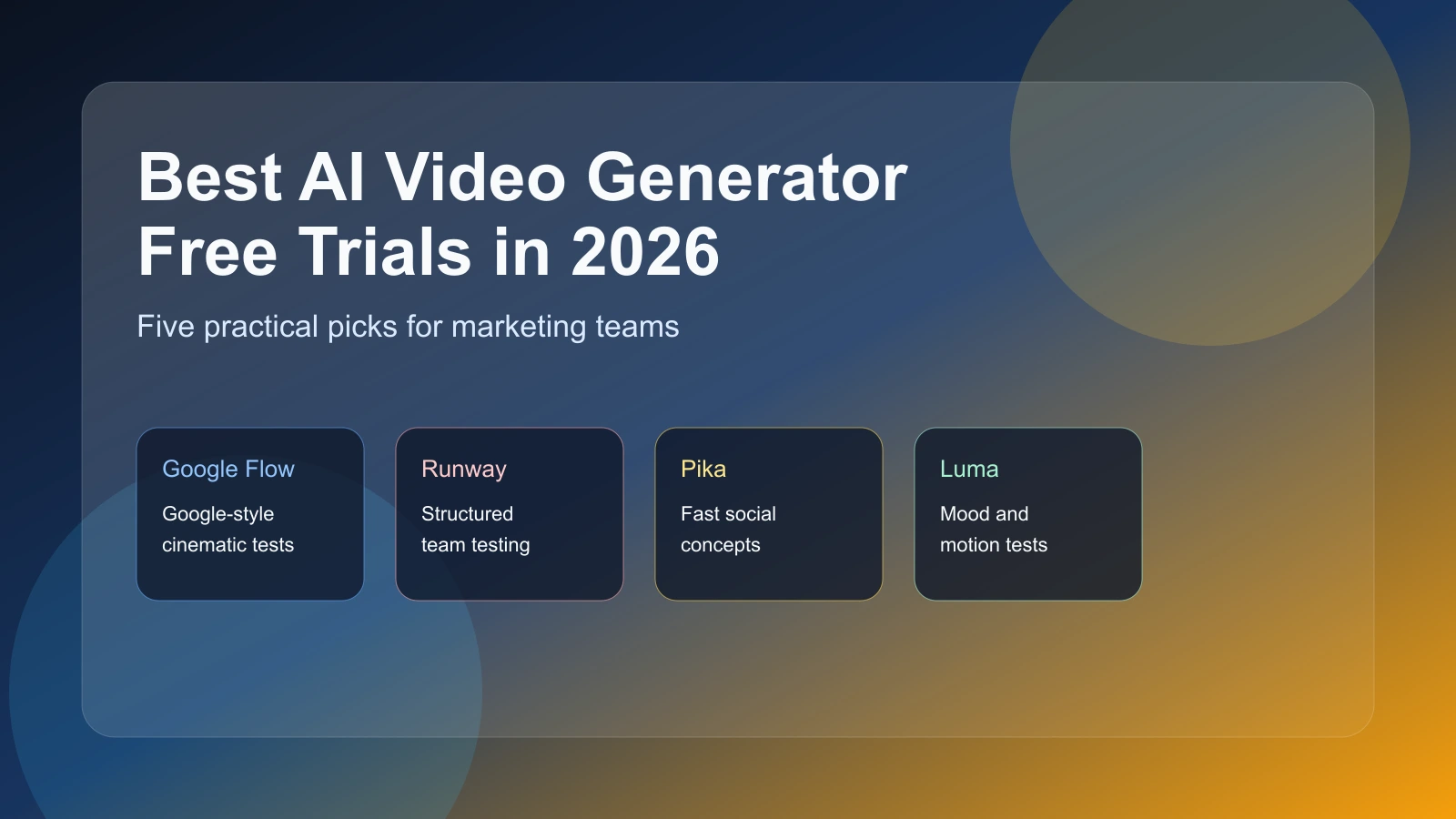
If you search for an ai video generator free in 2026, you usually do not want a long theory piece. You want to know which trial is actually worth your team's time before you commit budget, workflow, and campaign deadlines.
That is the real decision.
Most free trials look generous until you hit the limit that matters: watermarking, non-commercial rules, low resolution, slow queues, weak collaboration, or credits that disappear before a team can finish one useful test cycle.
This guide focuses on the practical marketing question:
- which free trial is strong enough for real creative evaluation
- which one is only good for rough concept testing
- which tools are best for short ads, social cuts, product explainers, and campaign experiments
- when a multi-model workspace is a better use of time than testing one vendor at a time
If you want the broader workflow first, start with AI Video Generator. If your question is specifically about the Google stack and current access reality, read /blog/is-veo-4-free. If you want the wider free-trial decision for a team, stay here.
The Short Answer
The best AI video generator free trial depends on what your team is trying to prove.
| Tool | Best for | What the free trial is good at | Main limitation |
|---|---|---|---|
| Google Flow | Testing Google-style cinematic output early | Strong first look at prompt-to-video quality and current Veo-style workflows | Availability and credit terms can vary by account and region |
| Runway | Structured concept testing with a familiar creative app feel | Clean interface for quick storyboard and short motion tests | Free credits are limited and the plan stays visibly trial-grade |
| Pika | Fast social concepts and effect-led short clips | Easy to test playful formats, punchy hooks, and short campaign ideas | Resolution and credit limits make it a rough-test tool more than a shipping tool |
| Luma Dream Machine | Mood-first visual ideation | Good for seeing motion feel, atmosphere, and shot energy quickly | Free tier keeps drafts low-priority, watermarked, and non-commercial |
| Veo4 | Teams that want one workspace to evaluate multiple production paths | Lets a team move from trial clips to a repeatable campaign workflow faster | Trial details matter less than whether the team actually adopts the workflow |
For most marketing teams, the right decision is not "which free trial has the biggest headline number." It is "which one helps us learn the fastest with the fewest dead-end steps."
How I Judged These Free Trials
This is a marketing-team review, not a hobbyist roundup.
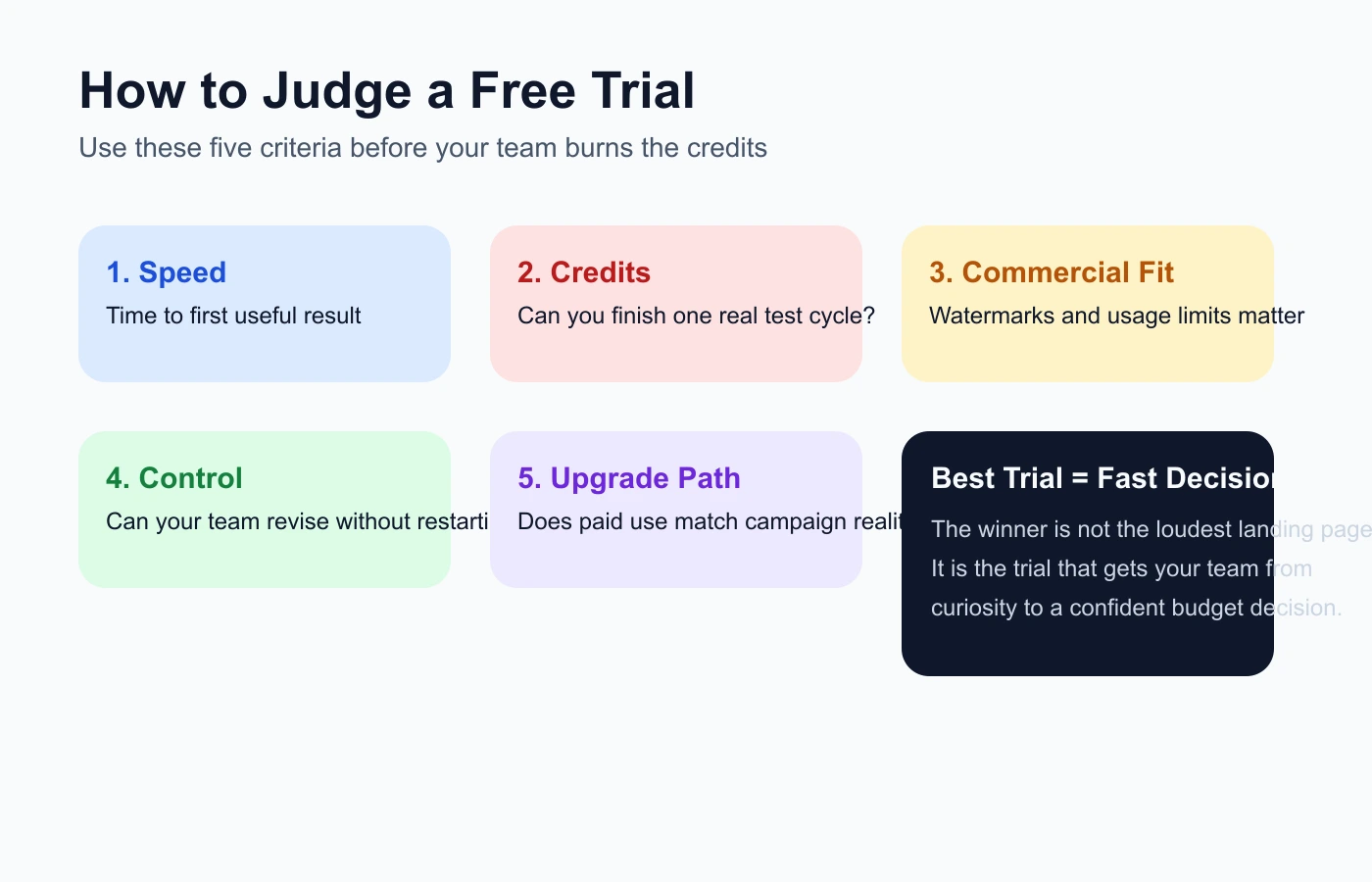
I ranked the options using the decision points that matter in real content operations:
Time to first useful result: Can a team get a usable draft on day one?Trial clarity: Are the limits obvious, or do they only show up after setup?Commercial usefulness: Can the trial support genuine campaign evaluation, not only toy tests?Workflow fit: Does the tool help with short ads, launch clips, social posts, and product storytelling?Upgrade logic: If the test works, is the path to paid use sensible?
That framework matters because many free tiers fail at the exact moment a team gets serious. The model may look impressive in the first five minutes and still be a bad fit for weekly campaign production.
As of April 6, 2026, the five options below are the most practical places to start if your team needs to test AI video without committing too early.
The 5 Best AI Video Generator Free Trials for Marketing Teams
1. Google Flow: Best for testing the Google-style look first
If your team specifically wants the polished, cinematic, Google-style output that keeps showing up in Veo-related search demand, Flow is the first place to test.
That does not mean it is automatically the best overall team workflow. It means it is the clearest place to evaluate whether the Google video stack is actually the visual direction your team wants.
The practical upside is clear:
- Flow is built around current Google video workflows rather than generic video templates.
- It is the closest public testing surface for teams chasing the Veo-style look.
- It helps answer the question "does this visual style justify deeper investment?" before you build a larger process around it.
The catch is just as important:
- Google's public credit and plan messaging still changes faster than most teams expect.
- Some public pages now present a free tier with starter credits and daily refreshes.
- Other Google help surfaces still frame access through paid Google AI plans.
- Regional rollout and account-level availability can still affect what your team actually sees.
That means Flow is best treated as a high-priority evaluation trial, not as a universally predictable free program.
Best for:
- teams testing Google-style cinematic output
- product marketers evaluating premium launch visuals
- creative leads deciding whether the Google route deserves paid rollout
Less ideal for:
- teams that need a stable free environment across multiple collaborators
- operators who want one place to compare several model directions side by side
My take: start here if the visual target is the reason for the search. Do not start here if your real need is team workflow flexibility.
2. Runway: Best for structured creative testing
Runway remains one of the easiest places for a marketing team to run disciplined trial experiments.
The free plan is not generous enough for heavy production. It is useful because the product surface is organized enough that a team can answer practical questions fast:
- Can we get a believable first-pass motion result?
- Can our team brief this tool consistently?
- Does the output hold up for ad hooks, short explainers, or product storytelling?
The free plan currently gives a limited one-time credit balance and keeps the experience visibly trial-level. That sounds restrictive, but for many teams that is still enough to judge whether the workflow feels controllable.
Why Runway works well as a trial:
- the interface is easy for non-technical teams to test
- the workflow feels closer to a creative app than a raw model console
- it is good for storyboards, motion roughs, and visual concept proofing
Why Runway is not the best pure free option:
- the credit pool is finite and disappears quickly
- the free plan is better for proving direction than for finishing campaigns
- teams hit the ceiling fast once they move from demos to repeatable use
Best for:
- structured team trials
- ad concept boards
- short campaign experiments
- marketers who want to evaluate control, not just spectacle
Less ideal for:
- teams hoping to run a serious free production queue
- operators who already know they will need many variations
My take: Runway is one of the best places to test whether your team can actually adopt AI video as a workflow, not just as a novelty.
3. Pika: Best for quick social-first concept tests
Pika is a strong trial if your team wants to test short-form creative energy quickly.
It is especially useful when the question is not "can this become our whole studio?" but "can this help us generate hooks, punchy visuals, or fast social concepts with low friction?"
The free Basic plan keeps enough monthly video credits for lightweight testing, which makes it practical for:
- rapid campaign hook exploration
- short social variations
- effect-led motion ideas
- quick product teaser experiments
The main limitation is that the free tier stays small enough that teams should not confuse it with a production environment. It is a testing lane.
Why Pika works:
- low-friction trials are good for busy marketing teams
- the tool is fast to understand
- it helps teams decide whether short-form AI motion is worth deeper effort
Why Pika can disappoint if expectations are wrong:
- the free plan is not built for a long review-and-revise cycle
- output limits make it a concept tool before it becomes a dependable shipping tool
- teams doing polished product ads will outgrow the free plan quickly
Best for:
- social teams
- brand experimentation
- hook testing for paid social
- lightweight campaign ideation
Less ideal for:
- teams that need longer evaluation windows
- higher-resolution approval workflows
- teams testing for multi-step production continuity
My take: Pika is one of the fastest free trials to learn from, but it is not the strongest one to build a marketing operation around.
4. Luma Dream Machine: Best for mood and motion ideation
Luma Dream Machine is strongest when your team wants to judge motion feel, atmosphere, and visual energy.
It is less about building a rigid production workflow and more about answering early creative questions:
- Does this campaign direction feel cinematic enough?
- Does this concept have emotional motion?
- Can we get a stronger visual mood than static mockups alone?
That makes Luma useful in the very early part of the process, especially for pitch decks, concept boards, and direction-setting.
The reason it ranks below Flow and Runway for most teams is simple. The free plan stays clearly draft-oriented:
- lower priority
- watermarks
- non-commercial positioning on the free tier
- lower-resolution evaluation output
Those limits are manageable if your team is only testing direction. They become a real problem if your team hopes the free trial will double as a publishing workflow.
Best for:
- creative direction tests
- launch concept boards
- mood-heavy product storytelling
- early-stage ideation before a team commits to paid production
Less ideal for:
- free commercial usage evaluation
- operational team reviews that need cleaner deliverables
- marketers who want to move directly from trial to campaign asset
My take: Luma is a good taste test. It is a weaker operations test.
5. Veo4: Best for teams that want a usable workflow, not just a trial
If your team already knows that the real problem is workflow fragmentation, Veo4 is the most practical pick in this list.
The point is not that a free trial alone makes it the winner. The point is that many teams waste free-trial time because they test one isolated tool at a time and never answer the bigger operational question:
"How do we go from prompt experiments to repeatable campaign output without rebuilding the process every week?"
That is where is useful.
Its product positioning is stronger for teams than for one-off testers:
- a free trial includes credits to generate multiple videos
- the paid plans are already structured around credits, recurring output, and commercial use
- the workflow is designed for real publishing use cases, not only isolated demos
- the site already supports the broader AI video journey through
/ai-video-generatorand/pricing
This matters because a marketing team usually does not need only one model. It needs:
- a faster testing loop
- consistent prompt iteration
- cleaner handoff from concept to asset
- a path from evaluation to publishing without switching mental models every day
Best for:
- teams comparing several creative directions
- marketers who need a usable operating layer, not just a fun free demo
- operators moving from trial clips to campaign workflow
Less ideal for:
- users who only want to test one vendor's native console for five minutes
- teams that have already standardized on a single closed ecosystem
My take: if your team is serious about adopting AI video rather than only sampling it, this is the most practical workflow-oriented choice in the list.
Best Free Trial by Team Goal
The easiest way to decide is to match the trial to the job.
| Team goal | Best starting trial | Strong alternative | Why |
|---|---|---|---|
| Evaluate the Google-style cinematic look | Google Flow | Veo4 | Flow answers the direct style question first; Veo4 is stronger if the team also needs workflow flexibility |
| Test whether AI video fits a repeatable marketing process | Runway | Veo4 | Both are good for structured evaluation, but Veo4 is better when workflow adoption matters more than isolated model testing |
| Generate fast social hooks and motion experiments | Pika | Runway | Pika is faster for rough concepting; Runway is more organized for broader review |
| Explore mood, motion, and concept direction | Luma Dream Machine | Flow | Luma is strong for ideation; Flow is stronger if the team wants the Google-quality route |
| Move from free testing into a real campaign pipeline | Veo4 | Runway | Veo4 is better aligned with team workflow continuity |
How Marketing Teams Should Use a Free Trial
The biggest mistake is treating a free trial like a playground instead of a test plan.
Your team should use the first 30 to 60 minutes to answer four questions only:
- Can we get one useful ad-style result from a clear brief?
- Can two different teammates reach similar quality?
- Can we revise toward a better version without starting from zero every time?
- If this works, is the upgrade path clear enough for campaign use?
If the answer to those four questions is yes, the free trial did its job.
If not, more credits usually will not fix the decision.
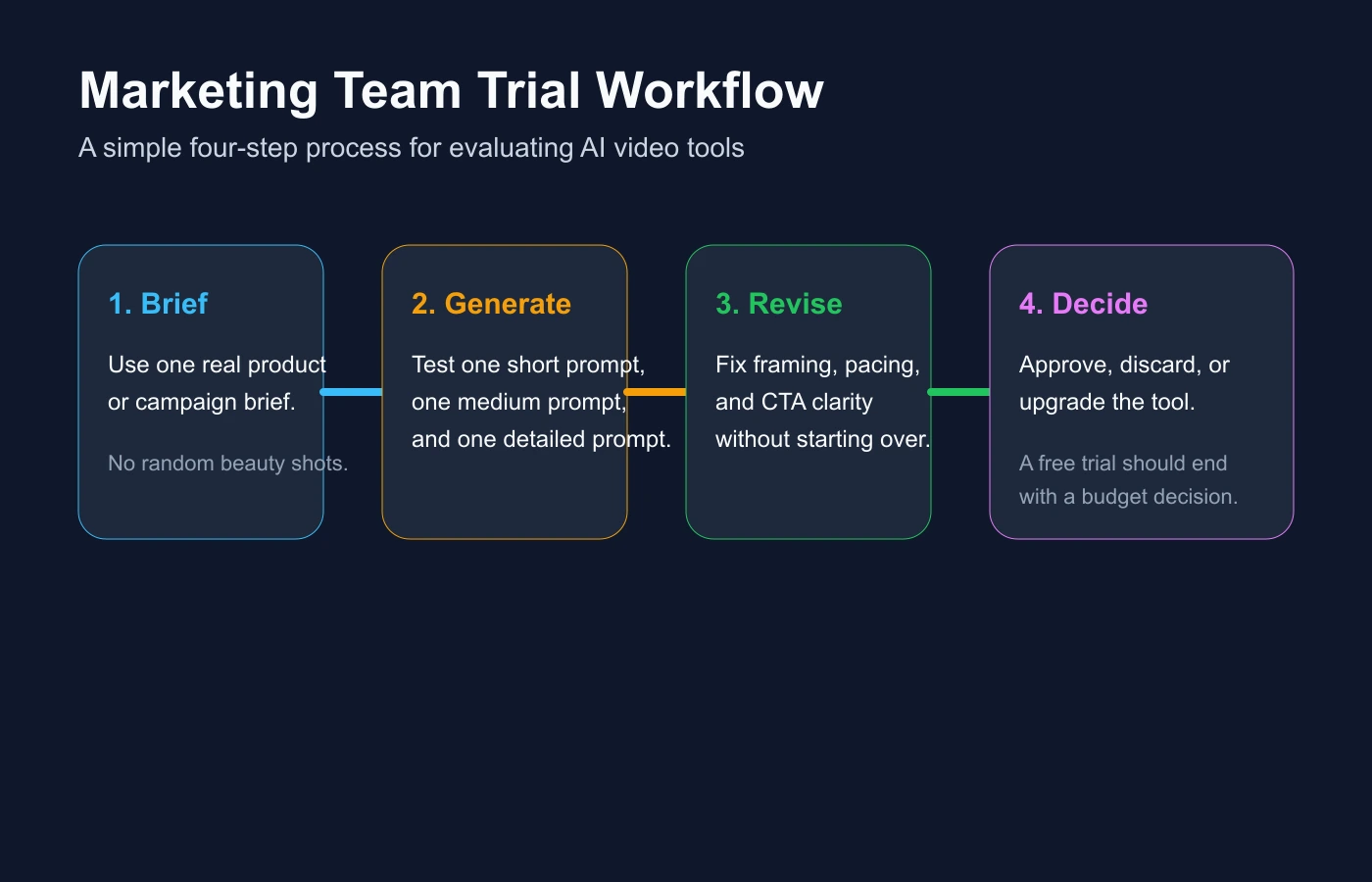
A simple evaluation workflow works best:
- choose one product or campaign brief
- write one short, one medium, and one detailed prompt
- test one landscape output and one vertical output
- compare first-pass quality, revision ease, and speed to usable result
- decide whether the tool belongs in concepting, production, or neither
What Most "Free AI Video Generator" Pages Miss
Most pages about ai video generator free make one of two mistakes.
They either:
- overvalue the raw credit number
- or treat every free trial like it has the same operational value
That is not how teams buy.
A small free plan can still be useful if it helps a team judge quality, speed, and revision behavior clearly. A bigger free offer can still be weak if it burns time in setup friction, confusing controls, or outputs that do not survive campaign review.
That is why the right question is not "which one is most free?"
The right question is:
"Which free trial helps our team make a confident decision fastest?"
Final Verdict
If your team wants the Google-style cinematic direction first, start with Google Flow.
If your team wants the cleanest structured test of whether AI video fits your process, start with Runway.
If your team wants fast short-form concepting, start with Pika.
If your team wants mood and motion ideation, start with Luma Dream Machine.
If your team wants a trial that points toward a practical publishing workflow rather than one more isolated test, start with Veo4.
The best free trial is not the one with the loudest landing page. It is the one that gets your team from curiosity to decision with the least wasted motion.
FAQ
Which AI video generator has the best free trial for marketing teams?
For most teams, the answer depends on the job. Flow is best for judging the Google-style look. Runway is best for structured workflow testing. Veo4 is best if the team cares about workflow continuity after the trial.
Are free AI video generator trials enough for real campaign work?
Usually not. Most free plans are best for evaluation, rough concepting, and first-pass testing. Serious publishing workflows usually need better resolution, more credits, faster queues, or commercial-use clarity.
What should a marketing team test first in a free AI video trial?
Test one real campaign brief, one social cut, one product-focused prompt, and one revision cycle. That reveals more than burning credits on random beauty shots.
Is "AI video generator free" the same as "commercially usable for free"?
No. Some tools let you test the product for free but reserve cleaner exports, higher resolution, or commercial use for paid plans. That is why commercial readiness matters as much as the free-trial headline.
Is it better to test one model deeply or several tools quickly?
For most marketing teams, it is better to test several tools quickly first, then go deep on the one that best matches your workflow, review process, and publishing needs.